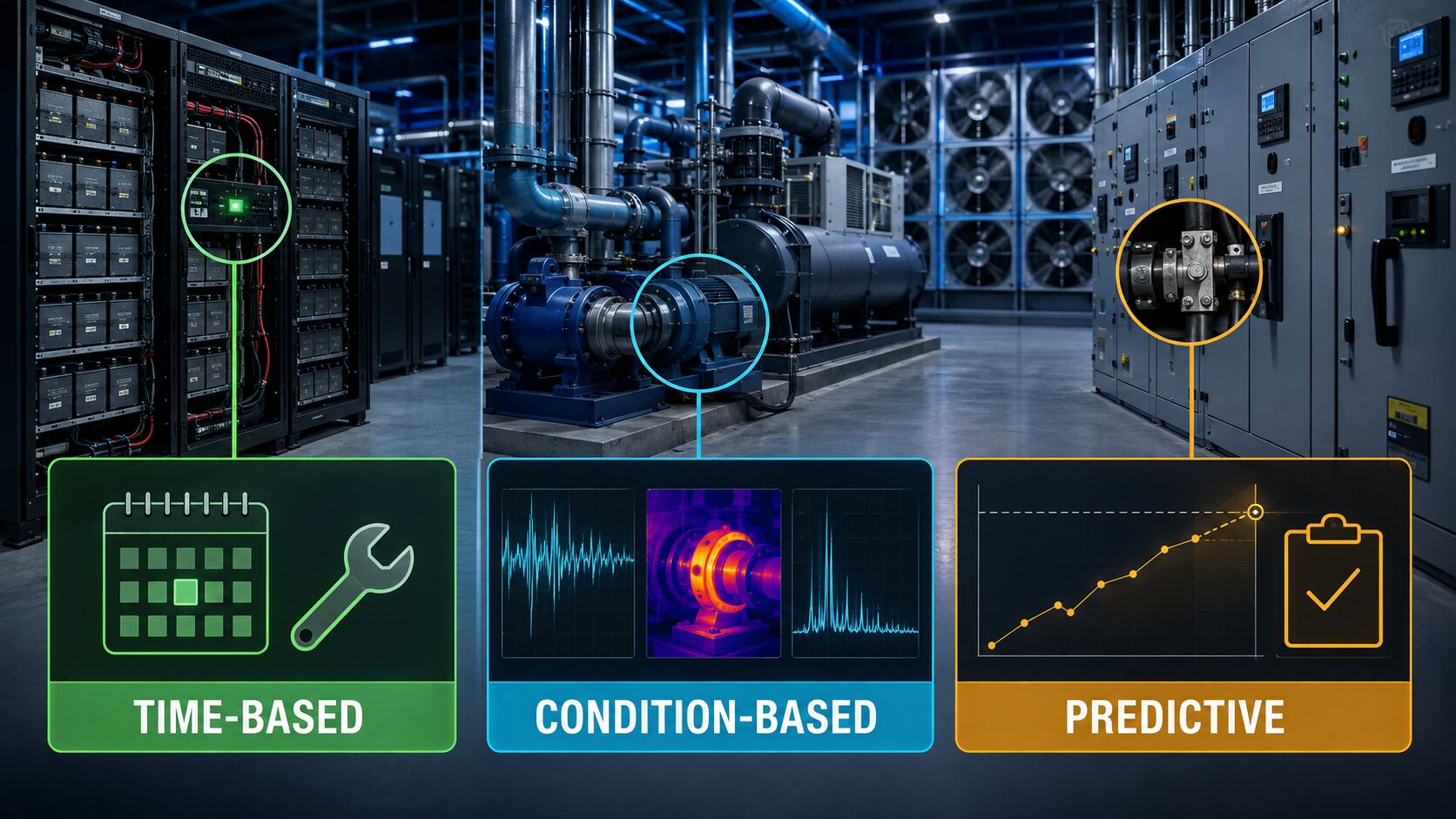
Not every component needs the same maintenance philosophy — batteries, bearings, and breakers fail in fundamentally different ways.
Three models, three different assumptions
The terms get used loosely, but they rest on different assumptions about how equipment fails:
- Time-based (preventive) maintenance assumes a component wears out at a roughly predictable rate, so servicing it on a fixed calendar interval catches problems before they cause failure. It works well when degradation is linear and inspection is cheap relative to the cost of a miss.
- Condition-based maintenance (CBM) assumes degradation is not linear or not predictable enough to trust a calendar, so it triggers work off measured condition — vibration, temperature, oil quality — instead of a date.
- Predictive maintenance goes further: it trends condition data over time to forecast when a component will cross a failure threshold, so work gets scheduled ahead of that threshold rather than reactively after an alarm.
None of these is universally “better.” The right model depends on how the specific component actually fails, and mismatching the model to the failure mode is where most maintenance programs quietly underperform.
Matching the model to the equipment
UPS batteries are a poor fit for pure time-based maintenance. Cell degradation and impedance rise are not linear, and a battery that passes a scheduled runtime test can fail weeks later. Impedance and internal resistance trending — a predictive approach — catches the drift that a calendar-based test schedule misses between visits.
Chillers and pumps benefit most from condition-based triggers layered under a time-based baseline. Routine inspection intervals still make sense for filters, belts, and lubrication, but vibration analysis and refrigerant trending catch bearing wear and charge loss that a fixed inspection interval would only find after the fact.
Cooling towers and fan wall units sit closer to condition-based than time-based, particularly at AI-hyperscale density. Fill fouling and basin water quality change on a schedule tied to usage and water chemistry, not the calendar — condition monitoring tracks the actual variable driving failure risk.
PDUs and transfer/tie switches (TOU) are a strong case for predictive thermal monitoring layered on top of time-based visual inspection. The failure mode that matters — connection or contact degradation at a joint or breaker — builds gradually and is invisible without a thermal trend, but the enclosure and mechanical components still warrant scheduled physical inspection.
The mistake to avoid
The most common error isn’t choosing the wrong model outright — it’s applying one model uniformly across an entire MEP fleet because it’s simpler to manage. A single condition-based sensor stack rolled out everywhere leaves slow, calendar-predictable components over-monitored and genuinely unpredictable ones under-monitored, at the same total cost as doing it properly.
The better question for each system isn’t “should this be predictive maintenance” — it’s “what does this specific component’s failure curve actually look like, and does the maintenance model match it.”
Put this into practice: Download the MEP Maintenance Model Selection Matrix to assess each asset’s failure pattern, select a time-based, condition-based, predictive, or hybrid strategy, assign controls, and document the reasoning in a workable Excel register.
Next in this series
The next posts in this series work through the sensor stack itself — what to actually instrument before calling a program “predictive” — followed by system-specific breakdowns starting with UPS and UPS batteries.

