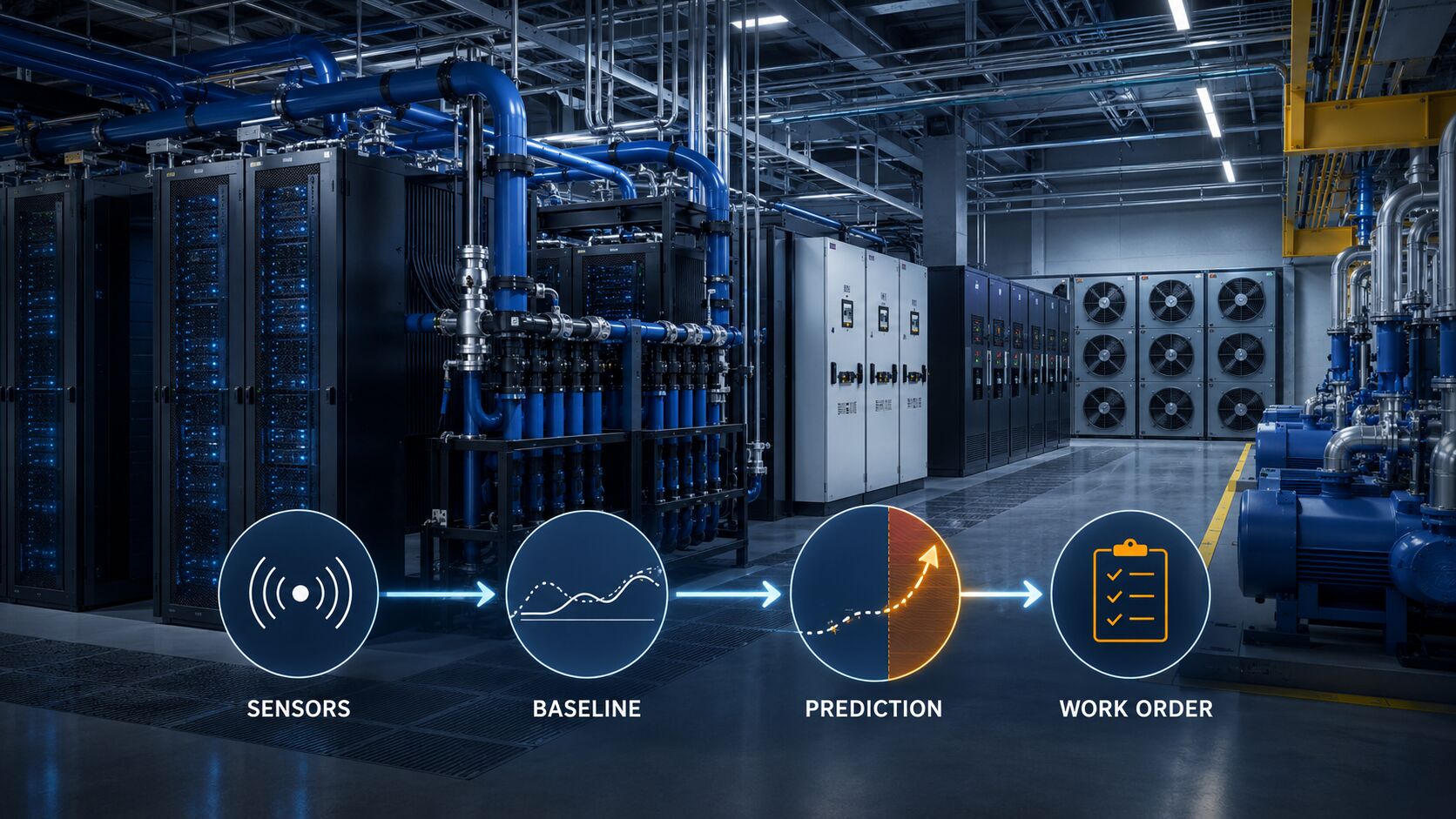
Predictive maintenance only works when sensor data, failure modes, and maintenance calendars are treated as one control loop — not three separate departments.
The old model was built for a different load profile
Traditional preventive maintenance (PM) runs on a calendar: quarterly UPS battery checks, annual chiller teardown, semi-annual PDU thermal scans. It assumes equipment degrades at a predictable rate and that the interval between failures is long enough to catch problems on schedule.
AI hyperscale facilities break that assumption in three ways:
- Higher power density per rack means MEP systems run closer to design limits more of the time, compressing the margin between “normal wear” and “failure.”
- Tighter thermal tolerances mean a cooling system anomaly that would have been a minor inefficiency in a traditional data hall becomes a thermal event within minutes in a high-density AI hall.
- Lower tolerance for unplanned downtime means the cost of missing a failure between scheduled inspections is no longer just a repair bill — it’s a load-shedding or outage event with contractual consequences.
A calendar-based PM program still finds problems. It just doesn’t reliably find them before they matter.
What condition-based and predictive maintenance actually change
Condition-based maintenance (CBM) triggers work orders off real equipment condition — vibration signatures, thermal signatures, oil analysis, impedance trending — instead of a fixed date. Predictive maintenance goes a step further, using trend data over time to forecast when a component will cross a failure threshold, so the work order gets scheduled before the equipment is actually degraded enough to fail.
Across the systems that matter most in an AI hyperscale facility, this looks like:
- UPS and UPS batteries — impedance and internal resistance trending catch cell degradation and imbalance long before a runtime test would show a problem, and well before a load event forces the issue.
- Chillers and pumps — vibration analysis and refrigerant trending pick up bearing wear, misalignment, and refrigerant charge loss while the equipment is still running within nameplate spec.
- Cooling towers and fan wall units (FWUs) — airflow, bearing temperature, and fill/basin condition data matter more at AI-hyperscale density, where a single degraded fan bank shows up in rack inlet temperatures within minutes rather than hours.
- PDUs and transfer/tie switches (TOU) — thermal imaging and contact-resistance trending catch the failure mode that actually causes most power distribution outages: connection degradation at a joint or breaker, not component failure inside the unit.
The common thread: none of these failure modes show up cleanly on a fixed-interval visual inspection. They show up in trend data.
The control loop, not the checklist
A predictive maintenance program is not an upgrade to the PM checklist — it’s a different structure entirely. It requires three things working together:
- Instrumentation matched to the failure mode. Vibration sensors answer a different question than thermal imaging, which answers a different question than oil analysis or power quality monitoring. Instrumenting only one and calling the program “predictive” leaves the other failure modes uncovered.
- A baseline, not just a threshold. Predictive trending is only meaningful against a documented baseline taken when the equipment was known-good — otherwise “abnormal” has nothing to be measured against.
- A path from alert to work order. Sensor data that doesn’t route into the CMMS or DCIM as an actionable, prioritized work order is just a dashboard. The program only pays off when the alert becomes scheduled labor before the failure becomes an incident.
Put this into practice: Download the AI Hyperscale Predictive Maintenance Control Template to build an asset register, map failure modes to sensors, establish known-good baselines, route alerts into work orders, and track preventive-maintenance optimization in one workable Excel control loop.
Where this series goes next
The rest of this series will work through each system in more depth — what to instrument, what failure modes actually matter, and where the sensor data should route. Coming up:
- UPS and UPS batteries: what impedance trending actually predicts
- Chillers and pumps: vibration baselines and refrigerant trending
- Cooling towers and fan wall units: airflow and fill/basin monitoring at hyperscale density
- PDUs and TOU: thermal scanning and contact-resistance trending
- Closing the loop: CMMS/DCIM integration without alarm fatigue
If the sensor stack, the baseline, and the work-order path aren’t all in place, the program isn’t predictive — it’s just a more expensive way to find out about a problem after the fact.

