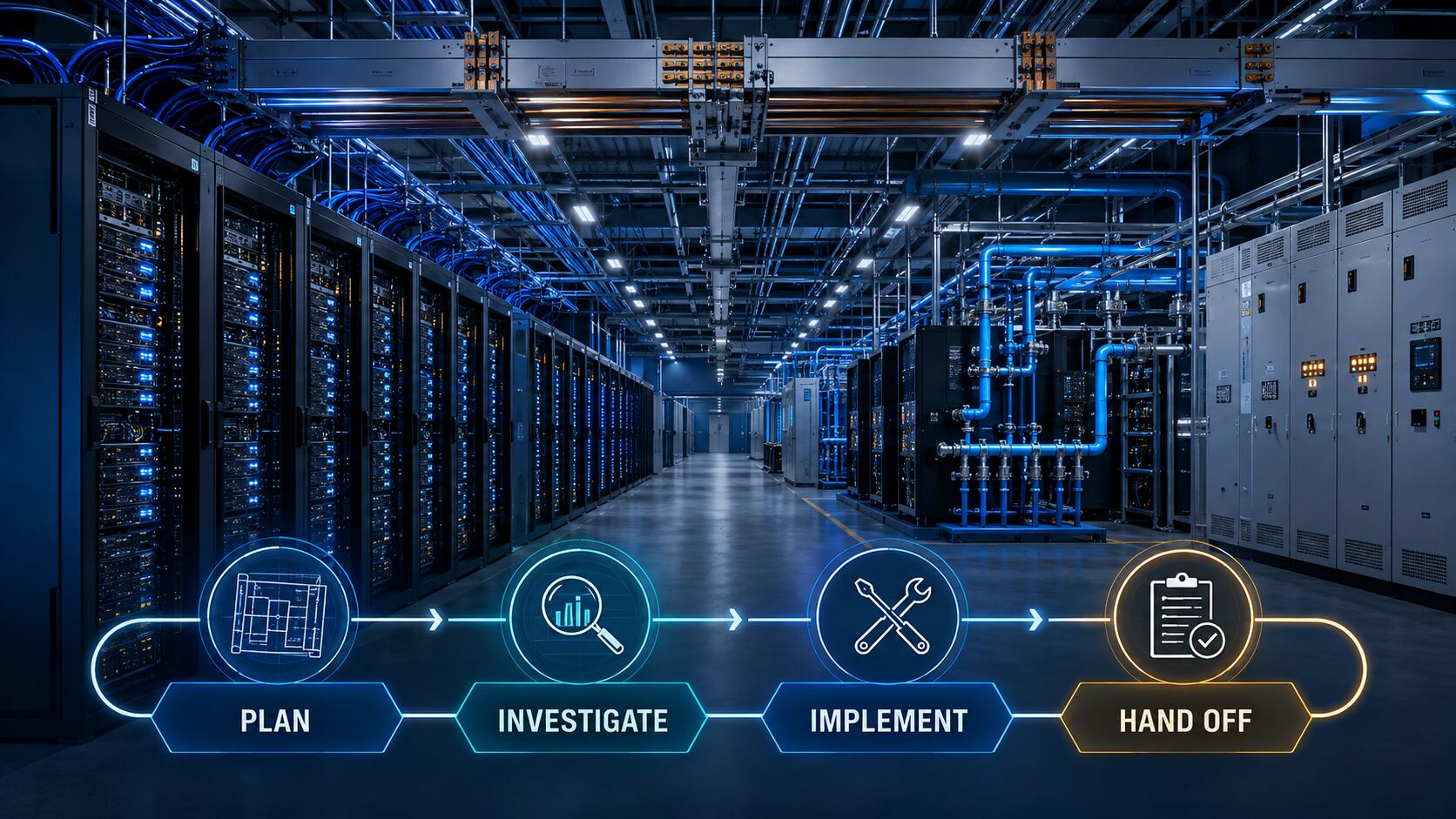
Commissioning is where a construction project either becomes an operable facility or becomes a punch list that never closes. For AI hyperscale sites — dense GPU racks, liquid cooling loops, and MV switchgear all going live under aggressive schedule pressure — the roadmap below treats commissioning as one continuous control process rather than four disconnected phases.
Why AI hyperscale changes the commissioning calculus
Traditional data center commissioning could tolerate some slack: air-cooled halls with mature CRAC/CRAH designs, lower rack densities, and years of institutional precedent. AI hyperscale removes that slack. A single CDU loop failure or a missed torque spec on a busway connection doesn’t just risk a few racks — it can take out a multi-million-dollar GPU cluster mid-training-run. The tolerance for “we’ll fix it after handover” collapses to near zero.
That’s the argument for treating commissioning as a single control loop — plan, investigate, implement, hand off — where each stage produces evidence the next stage consumes, rather than a checklist that gets signed once and filed away.
Plan: align scope, intent, and acceptance criteria
The planning stage is where most commissioning failures are actually seeded, long before a single cable is pulled. Three things need to be locked down and — critically — traceable back to a document, not a conversation:
- Scope boundary: what systems are in the commissioning envelope (MV switchgear, UPS/PDU, CDU/liquid cooling, BMS/EPMS integration, fire/life safety) and what’s explicitly excluded.
- Acceptance criteria: quantified pass/fail thresholds per system — not “cooling performs adequately” but specific delta-T, flow rate, and redundancy-loss recovery time targets.
- Vendor test responsibility matrix: who runs Level 3/4/5 functional tests, who witnesses them, and who signs off. On CSA-governed vendor relationships, this needs to be explicit in the contract language, not assumed.
A commissioning plan that skips straight to a test schedule without this groundwork produces exactly the kind of ambiguity that turns into disputed punch items during handover.
Investigate: verify installation and test the site
This is the Level 1–4 testing stage — factory witness, installation verification, functional performance testing, and integrated systems testing. For AI hyperscale specifically, a few areas deserve more rigor than legacy playbooks typically give them:
- Liquid cooling loop integrity: pressure decay testing, leak detection sensor validation, and CDU failover testing under simulated full-load heat rejection — not just a static pressure test.
- MV switchgear protection coordination: relay settings verified against the as-built one-line, not the design one-line — these drift during construction more often than teams expect.
- Integrated systems testing (IST): simulate a utility loss, a UPS-to-generator transfer, and a partial cooling loss simultaneously if the design claims to survive concurrent failure modes. Testing them individually and assuming superposition is a common and costly shortcut.
Every deficiency found here should be logged with a severity tier and a clear owner — this is the evidence trail that makes the “implement” stage auditable rather than reactive.
Implement: correct deficiencies and retest
Deficiency resolution is where schedule pressure does the most damage. The discipline that protects the facility is refusing to let “retest waived, verbal confirmation only” become normal practice. Every corrected deficiency gets a retest against the original acceptance criterion, and that retest result — not the original failure — is what goes into the commissioning record.
This is also the stage to formalize a severity-tiered escalation model (critical / major / minor) with defined resolution timelines, so deficiency backlogs don’t silently roll into operations as “known issues nobody owns.”
Hand off: preserve the baseline and support long-term operation
The handoff package is not a binder of As-Builts. It’s the operational baseline that L1/L2 teams will use for the life of the facility to distinguish “normal drift” from “developing fault.” At minimum it should include:
- Final test data for every system, tied back to acceptance criteria (not just a pass/fail stamp)
- As-commissioned setpoints and alarm thresholds, distinct from design intent values
- Open items log with severity and target closure dates — nothing gets buried
- MOP/EOP references for the systems just commissioned, so operations has a documented procedure on day one, not tribal knowledge
The facilities that avoid early-life reliability problems are the ones where this handoff package is actually used by the ops team in the first 90 days — not archived and referenced only during an incident postmortem.
The throughline
Plan, investigate, implement, and hand off aren’t sequential gates to clear — they’re a feedback loop. A weak plan produces ambiguous test criteria. Weak testing produces deficiencies that get corrected without being understood. And a rushed handoff turns a clean commissioning record into six months of firefighting for the operations team that inherits it. Treating the whole sequence as one continuous control process — with evidence carried forward at every stage — is what actually protects uptime once the facility goes live.
 Data Center Health