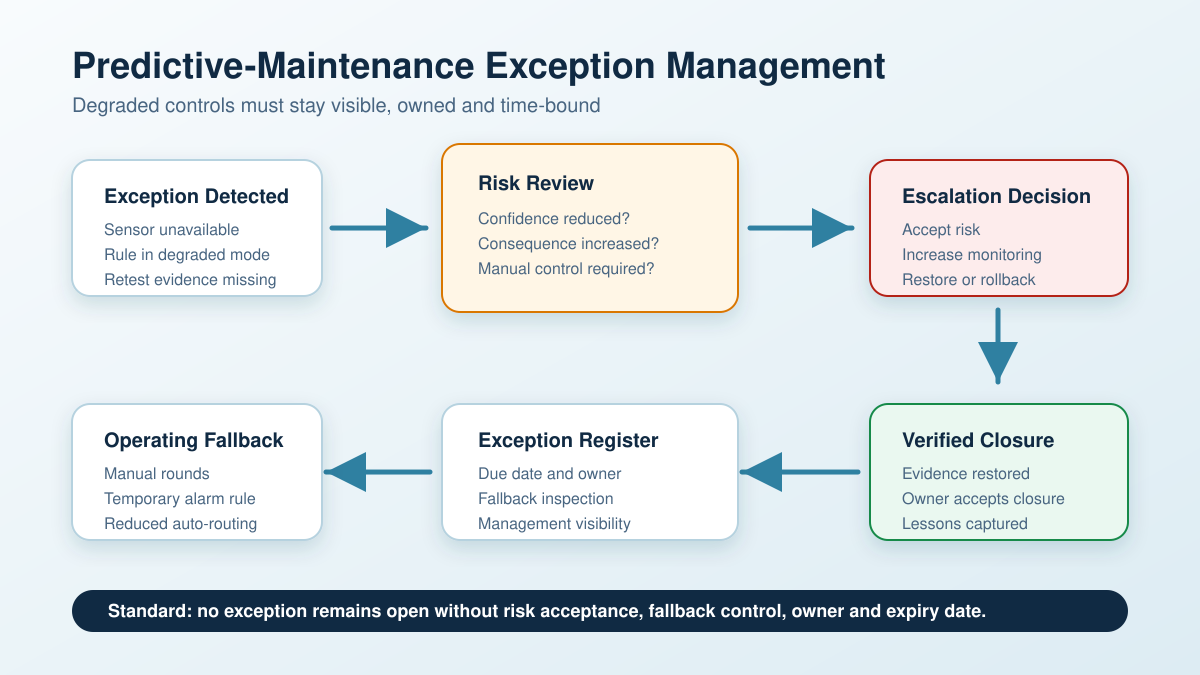
Predictive maintenance does not fail only when a sensor breaks or an alert is missed. It also fails when degraded controls become invisible. A sensor is unavailable, a model is under drift watch, a rule is running in degraded mode, a CMMS route is temporarily disabled, or a repair is closed before comparable retesting. Everyone assumes someone is watching it, but no one owns the exception.
For AI data centers, exceptions must be managed as operational risk states. They should be visible, owned, time-bound and closed only when evidence has been restored or risk has been formally accepted.
Abbreviation reference
- AI — Artificial Intelligence: Analytical or software methods used to support prediction, classification, prioritization or decision support.
- BMS — Building Management System: Supervisory platform for building services such as cooling and environmental systems.
- EPMS — Electrical Power Monitoring System: Platform for electrical distribution, loading, power quality and related alarms.
- DCIM — Data Center Infrastructure Management: Software connecting facility, asset, capacity and service-dependency information.
- CMMS — Computerized Maintenance Management System: System for maintenance assets, work orders, job plans, labor, parts and maintenance history.
- OT — Operational Technology: Systems that monitor or control physical equipment and processes.
- KPI — Key Performance Indicator: A defined measure used to assess performance or control effectiveness.
- OEM — Original Equipment Manufacturer: The equipment manufacturer and source of product-specific requirements.
An exception is not the same as an alert
An alert says something happened. An exception says the control system itself is not operating as intended or the normal evidence chain is incomplete. Treating both as ordinary tickets creates confusion.
Examples include:
- A critical thermal sensor is unavailable.
- A predictive rule is temporarily disabled during troubleshooting.
- A model is under drift review and outputs require manual approval.
- A BMS or EPMS tag mapping is suspected to be wrong.
- DCIM service-dependency data is incomplete.
- CMMS auto-routing is unavailable.
- Maintenance suppression has been extended beyond the approved window.
- Corrective work is complete but retest evidence is missing.
- A baseline cannot be trusted after equipment or operating changes.
The operational question is simple: while the normal predictive control is degraded, what protects the asset and who owns the risk?
Classify exceptions by confidence, consequence and coverage
The severity of an exception depends on what confidence has been lost, what equipment or service is affected and whether another credible control remains in place.
- Confidence loss: Is the evidence stale, missing, uncertain or manually substituted?
- Consequence: What happens if the affected asset fails during the exception period?
- Coverage: Is there another sensor, inspection method, alarm or operating control that can temporarily compensate?
- Duration: How long will the exception remain open?
- Urgency: Is the condition changing, or is redundancy reduced?
A missing sensor on a redundant non-critical fan may justify scheduled correction. A missing thermal indication on the only available power path serving a high-density AI row may require immediate manual inspection and escalation.
Do not allow “temporary” exceptions to become permanent
Exception management should prevent the common failure where a workaround becomes normal. Every exception should have an owner, expiry date and review cadence.
The record should include:
- Exception ID
- Affected asset, component, rule, model, sensor or integration
- Reason the normal control is degraded
- Confidence impact
- Operational consequence
- Fallback monitoring method
- Risk owner and acceptance authority
- Due date and expiry condition
- Escalation trigger
- Closure evidence required
Fallback controls must be practical
A fallback is not a sentence in a procedure. It is a working control that can be performed, evidenced and reviewed. If a PDU thermal node is unavailable, the fallback may be a manual infrared scan under comparable load. If CMMS routing is down, the fallback may be manual work-order creation from an analytics queue with duty-manager acknowledgement.
Fallback controls should define:
- Who performs the check
- How often it is performed
- What evidence is captured
- What threshold escalates the issue
- What happens if the fallback cannot be performed
- What condition allows return to normal
Accepted risk must be explicit
Some exceptions cannot be fixed immediately. That does not mean the risk disappears. It means the right person must explicitly accept the residual risk for a defined period.
Risk acceptance should state:
- The condition being accepted
- The reason immediate restoration is not possible
- The compensating controls in place
- The assets or services exposed
- The person accountable for the decision
- The expiry date
- The event that will trigger escalation before expiry
Close exceptions only with evidence
An exception should not close because a meeting ended or a ticket was updated. It should close because the normal control has been restored, an alternate control has been formally approved, or the underlying condition has been resolved and verified.
Closure evidence may include:
- Sensor replacement and calibration verification
- Restored tag feed and timestamp check
- Successful CMMS routing test
- Comparable retest after corrective work
- Model drift review and human validation sample
- Approved baseline reset
- Updated SOP, MOP or EOP where required
Measure exception health
Useful exception KPIs include:
- Open exceptions by consequence level
- Exceptions without fallback controls
- Accepted risks nearing expiry
- Overdue exceptions
- Average exception age
- Repeated exceptions by asset, rule or platform
- Exceptions closed with evidence
- Manual work orders created during routing outages
- Predictive findings delayed by degraded controls
The goal is not zero exceptions. The goal is no hidden exceptions.
Put this into practice
Use the companion workbook to register degraded controls, classify risk, define fallback monitoring, record accepted risk, escalate overdue items, verify closure evidence and report exception health to management.
Download the Predictive-Maintenance Exception Management Workbook
A biblical perspective on exposed risk
“The prudent see danger and take refuge, but the simple keep going and pay the penalty.”
— Proverbs 22:3 (NIV)
Wisdom does not pretend danger is absent. It sees exposure clearly and responds before harm occurs. Exception management follows the same principle. When a predictive-maintenance control is degraded, the responsible action is to make the risk visible, assign ownership, apply a practical refuge through fallback controls and restore confidence as soon as possible.
The operating standard
A predictive-maintenance exception is acceptable only when the organization knows what evidence is degraded, who owns the risk, what fallback is active, when the exception expires and what proof is required to close it.
Research references
- NIST SP 800-82 Rev. 3 — OT security guidance that emphasizes performance, reliability and safety needs in operational technology environments.
- NIST Cybersecurity Framework 2.0 — Govern, Identify, Protect, Detect, Respond and Recover functions for operationalizing risk management.
- ISO 55001:2024 — Asset-management-system requirements supporting risk, performance, lifecycle control and improvement.
- U.S. DOE FEMP O&M Best Practices — Operations and maintenance guidance for effective maintenance management and operational efficiency.

