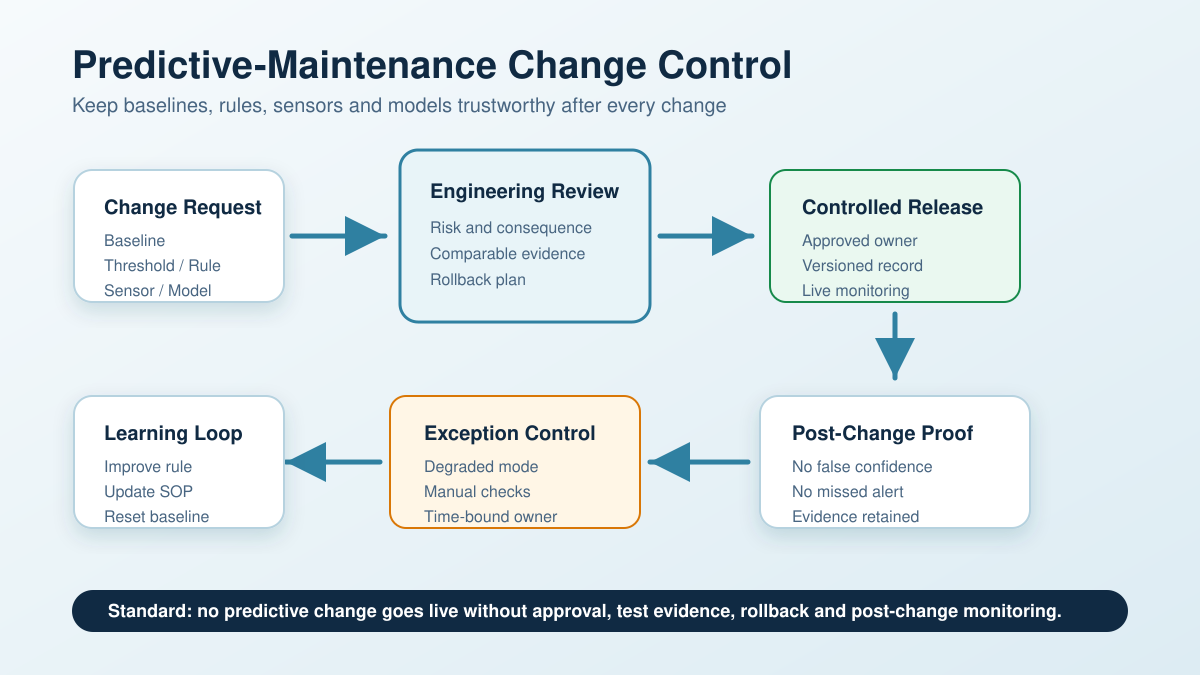
Predictive maintenance becomes fragile when the program changes faster than its evidence controls. A baseline is reset after repair. A vibration threshold is adjusted to reduce false positives. A sensor is replaced. A model is retrained. A Data Center Infrastructure Management (DCIM) dependency is updated. A Computerized Maintenance Management System (CMMS) routing rule is changed.
Each change may be reasonable. The risk is that the organization loses the ability to explain why an alert fired, why another alert did not fire, or whether a completed repair was evaluated against the right acceptance criterion.
For AI data centers, predictive-maintenance change control is therefore not paperwork. It protects decision trust.
Abbreviation reference
- AI — Artificial Intelligence: Analytical or software methods used to support prediction, classification, prioritization or decision support.
- BMS — Building Management System: Supervisory platform for building services such as cooling and environmental systems.
- EPMS — Electrical Power Monitoring System: Platform for electrical distribution, loading, power quality and related alarms.
- DCIM — Data Center Infrastructure Management: Software connecting facility, asset, capacity and service-dependency information.
- CMMS — Computerized Maintenance Management System: System for maintenance assets, work orders, job plans, labor, parts and maintenance history.
- OT — Operational Technology: Systems that monitor or control physical equipment and processes.
- RACI — Responsible, Accountable, Consulted and Informed: A method for assigning roles in a process or decision.
- SOP/MOP/EOP — Standard, Method of Procedure and Emergency Operating Procedure: Controlled instructions for normal, planned and emergency work.
- KPI — Key Performance Indicator: A defined measure used to assess performance or control effectiveness.
- OEM — Original Equipment Manufacturer: The equipment manufacturer and source of product-specific requirements.
Why predictive-maintenance changes need their own control
Conventional maintenance change control often focuses on physical work: replacing equipment, changing a setpoint, modifying a sequence or approving an outage. Predictive maintenance adds another layer. The decision logic itself can change.
The following changes can materially affect trust:
- Resetting a known-good baseline
- Changing warning, alarm or danger thresholds
- Adding persistence, suppression or deduplication rules
- Replacing or relocating a sensor
- Changing calibration or verification method
- Updating asset-to-service mappings in DCIM
- Changing CMMS routing, priority or required fields
- Modifying OT gateways, tag names, APIs or historians
- Retraining or replacing an AI model
- Changing the acceptance criterion used for closure
NIST SP 800-82 Rev. 3 treats OT systems as environments where cybersecurity controls must respect performance, reliability and safety requirements. That principle applies directly to maintenance-data changes: a technically valid update can still create operational risk if it reduces visibility, breaks traceability or changes decision behavior without review. NIST AI RMF similarly frames AI risk management around governing, mapping, measuring and managing risks across the lifecycle rather than treating a model as a one-time asset.
Separate the change types
Not every predictive-maintenance change has the same risk. A useful register separates changes into practical categories.
Baseline changes
A baseline should represent a known-good condition under comparable operating conditions. Resetting it after repair, replacement or seasonal change may be correct, but the reason must be visible. If a deteriorated condition is accidentally accepted as the new normal, future warnings may disappear.
Rule and threshold changes
Thresholds, persistence rules, deduplication keys and suppression logic determine what becomes visible to operators and maintenance teams. A threshold change should therefore be tested against historical events, known false positives and high-consequence failure scenarios.
Sensor and measurement changes
Replacing a sensor is not only a hardware task. The measurement point, mounting method, orientation, calibration status, timestamp behavior and data path must still match the failure mode being monitored.
Model changes
An AI model update should not move directly from training to production. It needs an intended-use statement, validation scope, explainability review, false-positive and false-negative review, drift monitoring and rollback version.
Integration and routing changes
Changes to BMS, EPMS, historian, DCIM or CMMS mappings can affect asset identity, service consequence and response ownership. A wrong tag or routing rule may be less visible than a failed sensor but more damaging to the operating process.
Use a minimum change record
Every material predictive-maintenance change should record:
- Change ID and type
- Affected site, asset, component and measurement point
- Reason for change
- Current approved configuration
- Proposed configuration
- Failure mode and decision affected
- Operational consequence if wrong
- Confidence impact
- Test evidence required before release
- Rollback method
- Owner and approver
- Planned release date
- Post-change monitoring window
- Closure evidence
The record should make one thing clear: what decision will change if this configuration changes?
Do not reset a baseline without proving the new normal
ISO 17359 provides general guidance for establishing condition-monitoring programs for machines. In practical terms, the monitoring baseline must be tied to equipment condition and operating context. For data-center MEP assets, this means load, speed, flow, ambient condition, water chemistry, electrical load and redundancy state may matter.
Before resetting a baseline, ask:
- Was the equipment verified healthy?
- Was corrective work completed and documented?
- Was the retest performed at a comparable load or duty?
- Was the same measurement point and method used?
- Is the old baseline retained for audit?
- Does the new baseline require a temporary monitoring window?
- Who approved the reset?
A repaired PDU lug, replaced fan motor or treated cooling-tower cell may deserve a new baseline. A deteriorating condition hidden by a baseline reset does not.
Test rule changes against both noise and missed events
Most rule changes are motivated by alarm noise. That is legitimate, but reducing false positives must not create unacceptable false negatives.
Before changing a rule, test it against:
- Known actionable events
- Known rejected or false-positive events
- High-consequence assets
- Reduced-redundancy operating states
- Seasonal or load-related variation
- Sensor-quality failures
- Maintenance-suppression windows
- Repeated alerts after corrective work
The release decision should state what improved, what risk increased and what will be watched after release.
Control model releases like operational assets
AI model updates require more than a new accuracy score. The model must remain fit for its intended maintenance use.
A model release pack should include:
- Intended use and prohibited use
- Training and validation data period
- Asset classes and operating conditions covered
- Known exclusions and weak coverage
- False-positive and false-negative review
- Explanation or feature-contribution method
- Human approval requirement
- Drift and performance monitoring
- Fallback or rollback version
- Release approver
For high-consequence MEP decisions, the model should support the decision rather than silently own it.
Protect OT and data-path changes
Predictive-maintenance data often crosses sensor networks, gateways, BMS, EPMS, historians, analytics platforms, DCIM and CMMS. NIST SP 800-82 emphasizes OT’s performance, reliability and safety requirements; this makes operational testing and rollback essential when changing the data path.
Before release, verify:
- The source tag maps to the correct asset and measurement point.
- Timestamps remain synchronized.
- Stale, frozen or missing data is detected.
- Security review is complete where a boundary changes.
- DCIM consequence and redundancy context is still correct.
- CMMS routing creates the intended work order fields.
- Fallback monitoring is available if the integration fails.
Use post-change monitoring as the release gate
A release is not complete when the configuration is saved. It is complete when the organization verifies that the change behaves safely in production.
Post-change monitoring should confirm:
- Expected alerts still fire.
- Known false positives are reduced or explained.
- No critical events are suppressed unexpectedly.
- CMMS work orders route to the correct owner.
- Evidence links remain intact.
- Dashboards and KPI calculations still reconcile.
- Exceptions are time-bound and owned.
If the post-change monitoring window fails, the decision should be explicit: rollback, continue in degraded mode, redesign or accept residual risk with management approval.
Measure the control, not just the change volume
Useful change-control KPIs include:
- Number of predictive-maintenance changes by type
- Percentage with approved risk classification
- Percentage with rollback defined before release
- Percentage with pre-release test evidence
- Percentage with completed post-change monitoring
- Unauthorized or emergency changes
- Changes causing data-quality or routing incidents
- Overdue exceptions and degraded-mode rules
- Repeat changes for the same failure mode
- Lessons converted into controlled procedure updates
A mature program does not merely change faster. It changes with evidence and learns from the result.
Put this into practice
Use the companion workbook to register predictive-maintenance changes, control baseline resets, test rule and model releases, manage sensor replacement evidence, assess OT integration risk, define approval ownership, monitor post-change behavior and report unresolved exceptions.
Download the Predictive-Maintenance Change-Control Workbook
A biblical perspective on tested changes
“Test everything. Hold on to the good.”
— 1 Thessalonians 5:21 (NIV)
Wise change is not careless experimentation. It is tested, examined and held only when it proves good. Predictive maintenance requires the same discipline. A new baseline, model, rule or integration should not be accepted simply because it is new or technically impressive. It should be examined against evidence, operational consequence and the responsibility to protect people, equipment and service continuity.
Stewardship means improving the system without losing the truth that makes the system useful.
The operating standard
A predictive-maintenance program can safely change when every material update has an owner, risk classification, test evidence, rollback path, release record and post-change monitoring result.
The goal is not to freeze the system. The goal is to improve it without breaking trust.
Research references
- NIST SP 800-82 Rev. 3 — Guide to Operational Technology Security
- NIST AI RMF 1.0 — Artificial Intelligence Risk Management Framework
- ISO 55001:2024 — Asset management system requirements
- ISO 17359:2018 — Condition monitoring and diagnostics of machines: General guidelines
- U.S. DOE FEMP — Operations and Maintenance Best Practices

