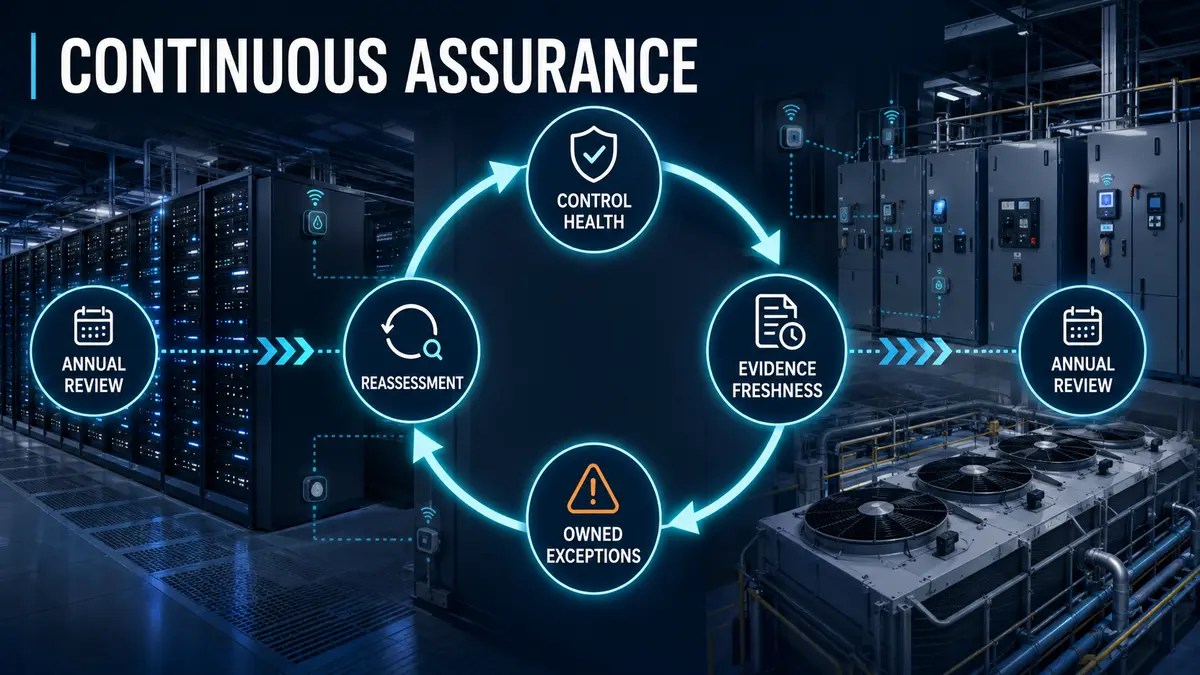
An annual maturity assessment can establish whether a predictive-maintenance program is operating as intended at one point in time. It cannot guarantee that the same controls will remain effective for the next twelve months.
Data-center operating conditions change continuously. Sensors are replaced. Firmware is updated. Contractors gain or lose access. Equipment loads shift. Asset mappings are revised. Models drift. Maintenance procedures change. New failure modes appear. A control that passed in January may no longer be reliable by June.
Continuous assurance closes that gap. It does not mean continuously auditing everyone or turning every exception into an incident. It means selecting the controls that matter most, monitoring evidence that shows whether they are still effective, assigning clear triggers and escalating material changes before the next annual review.
Abbreviation reference
- BMS — Building Management System: Supervisory platform for cooling, environmental and other building services.
- EPMS — Electrical Power Monitoring System: Platform for electrical distribution, loading, power quality and related alarms.
- DCIM — Data Center Infrastructure Management: Software connecting facility, asset, capacity and service-dependency information.
- CMMS — Computerized Maintenance Management System: System for maintenance assets, work orders, procedures, labor, parts and history.
- OT — Operational Technology: Systems that monitor or control physical equipment and processes.
- KPI — Key Performance Indicator: A defined measure used to assess performance or control effectiveness.
- KRI — Key Risk Indicator: A measure intended to show increasing risk exposure or weakening control.
- OEM — Original Equipment Manufacturer: The equipment manufacturer and source of product-specific requirements.
- RACI — Responsible, Accountable, Consulted and Informed: A method for assigning process and decision roles.
- SOP/MOP/EOP — Standard, Method of Procedure and Emergency Operating Procedure: Controlled instructions for normal, planned and emergency work.
Continuous assurance is not constant surveillance
ISO 55001:2024 addresses establishing, implementing, maintaining and improving an asset-management system. ISO 17359:2018 provides general procedures for setting up condition-monitoring programs for machines. The U.S. Department of Energy describes effective operations and maintenance as an integrated program that uses performance information and multiple maintenance approaches.
NIST Special Publication 800-137 addresses information-security continuous monitoring. Its direct scope is cybersecurity—not predictive maintenance. However, its management principle is useful when carefully adapted: organizations need ongoing visibility into assets and the effectiveness of deployed controls so they can respond when evidence shows that risk is no longer adequately controlled.
For predictive maintenance, continuous assurance should provide timely answers to five questions:
- Are the monitored assets, measurement points and service dependencies still correctly mapped?
- Is the incoming evidence sufficiently complete, current and trustworthy?
- Are rules, models and workflow controls behaving within their approved conditions?
- Are credible findings reaching accountable owners and closing through comparable retesting?
- Has any material change invalidated the assumptions behind the current control?
The objective is selective visibility into control health—not unrestricted monitoring of people.
Define the controls that deserve continuous attention
Not every annual-assessment criterion needs a real-time dashboard. Continuous assurance should focus on controls whose failure could quickly create hidden risk.
Measurement and data controls
Monitor:
- Sensor availability and quality flags
- Calibration or verification status
- Frozen, stale, missing and out-of-range data
- Clock offsets across BMS, EPMS, DCIM, historians and CMMS
- Changes in sampling rate, engineering units or scaling
- Baselines used outside approved load or environmental conditions
- Loss of corroborating evidence for high-consequence use cases
Analytics and rule controls
Monitor:
- Model or rule version in production
- Approved operating envelope
- Input-data drift
- Alert volume and severity distribution
- False-positive, invalid-data and repeat-alert trends
- Human overrides and rejected recommendations
- Unauthorized or undocumented rule changes
- Performance differences by equipment class, site and operating mode
Workflow and closure controls
Monitor:
- Critical events awaiting validation
- Validated events without an accountable owner
- Assignment and escalation timeliness
- Work orders missing the required evidence
- Repairs completed without comparable retesting
- Reopened or repeated conditions
- Approved suppression windows that remain active after planned work
- Actions overdue from incidents, audits and maturity assessments
Cybersecurity and resilience controls
Monitor:
- Connected-sensor and gateway inventory changes
- Remote-access accounts and sessions
- Privileged access outside approved windows
- Failed backups, restore tests and loss-of-communications exercises
- Unapproved firmware or configuration changes
- Certificates, credentials or support agreements approaching expiry
- Unresolved vulnerabilities affecting predictive-maintenance data paths
These controls do not all require the same frequency. The frequency should reflect how quickly the condition can change, the consequence of delayed detection and the cost of obtaining reliable evidence.
Separate health indicators, risk indicators and outcomes
One dashboard should not mix every measure without explaining what it means.
Control-health indicators
These show whether the process is operating as designed. Examples include percentage of critical sensors reporting valid data, percentage of production rules with current approvals and percentage of completed work with retest evidence.
Key risk indicators
These show increasing exposure. Examples include critical events awaiting ownership, repeated conditions on non-redundant assets, overdue calibration on protected-load equipment and remote-access exceptions that have exceeded their approved duration.
Outcome indicators
These show what the program achieved. Examples include failures detected before service impact, planned versus emergency interventions, repeat-alert rate after repair, finance-verified realized savings and confidence-adjusted avoided-risk scenarios.
Control health can deteriorate before an operating outcome becomes visible. Waiting for emergency work or service impact to rise means assurance started too late.
Use evidence-freshness rules
Evidence does not remain valid forever. Each material control should identify:
- Evidence owner
- Source system or repository
- Evidence type
- Required review frequency
- Maximum acceptable age
- Conditions that invalidate the evidence early
- Reviewer or acceptance authority
- Action if evidence is missing, stale or contradictory
A signed procedure may remain current for a year unless the equipment, workflow or safety requirement changes. A sensor-health result may be valid for minutes. A calibration certificate may remain valid until its approved expiry unless the instrument is damaged, repaired or exposed to conditions that invalidate calibration.
Freshness must therefore be defined by use—not by one universal retention period.
Build trigger-based reassessment
The annual review should be the maximum interval for the full program assessment, not the only time controls are reconsidered.
An out-of-cycle review should be triggered by material changes such as:
- A critical missed detection or false negative
- A high-consequence false positive that caused unsafe or unnecessary intervention
- Repeat failure after a supposedly verified repair
- Replacement of a sensor, gateway or analytics platform
- Material firmware, model, rule or baseline change
- Change in asset duty, redundancy or protected service
- Site expansion or transfer of a rule to another equipment class
- Supplier, remote-access or cybersecurity-control change
- Loss of key competence or a change in accountable ownership
- Significant data-quality or clock-synchronization failure
- New regulatory, contractual, OEM or safety requirement
The trigger should identify the scope of reassessment. A failed vibration sensor may require a use-case review. A historian timestamp failure affecting several systems may require a program-level review.
Establish a practical review cadence
Daily operational review
Focus on exceptions requiring action:
- Critical unvalidated observations
- High-priority events without ownership
- Data-quality failures affecting active use cases
- Suppressions outside approved work
- Work awaiting required retest
Weekly control-health review
Review trends and repeated exceptions:
- Invalid-data and stale-sensor trends
- Assignment and escalation breaches
- Repeat alerts
- Open high-risk actions
- Override and rule-change activity
- Vendor-access exceptions
Monthly assurance review
Reconcile the systems of record:
- BMS/EPMS/DCIM event counts against CMMS cases
- Production rules against the approved register
- Asset mappings against configuration changes
- Closed work against retest and acceptance evidence
- Sensor inventory against network and cybersecurity inventory
- KPI calculations against source definitions
Quarterly governance review
Challenge the program rather than simply receive a dashboard:
- Review critical gates and overdue actions
- Sample complete alert-to-closure cases
- Approve material deviations and rule changes
- Review data, model and cybersecurity exceptions
- Reconcile realized benefits and avoided-risk assumptions
- Decide which capabilities should scale, continue, redesign or retire
The cadence should be documented, but the program should escalate immediately when a defined trigger is reached.
Sample complete cases—not only exceptions
Exception reporting is efficient, but it can miss controls that appear healthy because the underlying measurement is incomplete. Periodic sampling should include:
- Successful planned interventions
- False positives and invalid-data events
- Alerts suppressed during maintenance
- Critical events escalated under reduced redundancy
- Work completed by external vendors
- Human overrides of analytics recommendations
- Model or rule changes
- Cases with realized financial benefits
- Cases closed without corrective work
For each case, trace the evidence from the original measurement through validation, prioritization, assignment, work, retest, acceptance, learning and financial classification.
Make every exception an owned decision
A continuous-assurance exception should record:
- Control and affected scope
- Detection time and source
- Evidence supporting the exception
- Risk and service consequence
- Available redundancy or compensating control
- Accountable owner
- Required response and due date
- Escalation threshold
- Closure evidence
- Decision to restore, accept, redesign or retire the control
An exception dashboard without ownership becomes another alarm screen. Aging, consequence and failed escalation should determine priority—not the number of comments attached to the record.
Avoid assurance theatre
Continuous assurance fails when organizations collect large volumes of evidence without testing whether the control works.
Warning signs include:
- All indicators remain green because thresholds were never challenged
- Reviews count tickets but do not sample evidence quality
- Dashboards show averages while critical exceptions are hidden
- Stale procedures remain “current” because no trigger was defined
- Model performance is reported without segmenting by site or equipment class
- Closed work is counted without comparable retesting
- Exceptions are repeatedly accepted without expiry dates
- Annual findings remain open while the reported maturity score increases
The purpose is not permanent green status. A credible program will sometimes show amber or red because it detects its own weakening controls early.
Put this into practice
Use the AI Data Center Predictive-Maintenance Continuous-Assurance Workbook to register critical controls, define evidence-freshness rules, monitor control health and key risk indicators, record trigger events, manage exceptions, sample complete cases, track quarterly governance decisions and present an executive dashboard.
Download the Excel Continuous-Assurance Workbook
A biblical perspective on watchfulness
“Be alert and of sober mind. Your enemy the devil prowls around like a roaring lion looking for someone to devour.”
— 1 Peter 5:8 (NIV)
The verse speaks about spiritual vigilance, not maintenance technology. Its principle of alertness still provides a useful reflection: important responsibilities should not be handled carelessly or assumed to remain safe without attention.
Continuous assurance is disciplined watchfulness applied to the controls protecting people, equipment and service. It asks whether evidence is still trustworthy, whether exceptions have owners and whether changes have weakened safeguards. Watchfulness does not mean fear or constant alarm. It means remaining clear-minded, recognizing material change and acting before neglect becomes failure.
The control between the reviews
Annual assessment establishes direction and an evidence-based maturity baseline. Continuous assurance keeps that conclusion from becoming stale.
A predictive-maintenance program remains trustworthy when it can detect weakening controls, identify material change, assign exceptions, verify corrective action and trigger reassessment before the next scheduled review.
The practical test is simple:
If an important control stopped working today, how soon would the organization know—and who would be accountable for restoring it?
Research references
- NIST SP 800-137 — Information Security Continuous Monitoring
- NIST SP 800-137A — Assessing Information Security Continuous Monitoring Programs
- ISO 55001:2024 — Asset management system requirements
- ISO 17359:2018 — Condition monitoring and diagnostics of machines: General guidelines
- U.S. Department of Energy — Operations and Maintenance Challenges and Solutions

