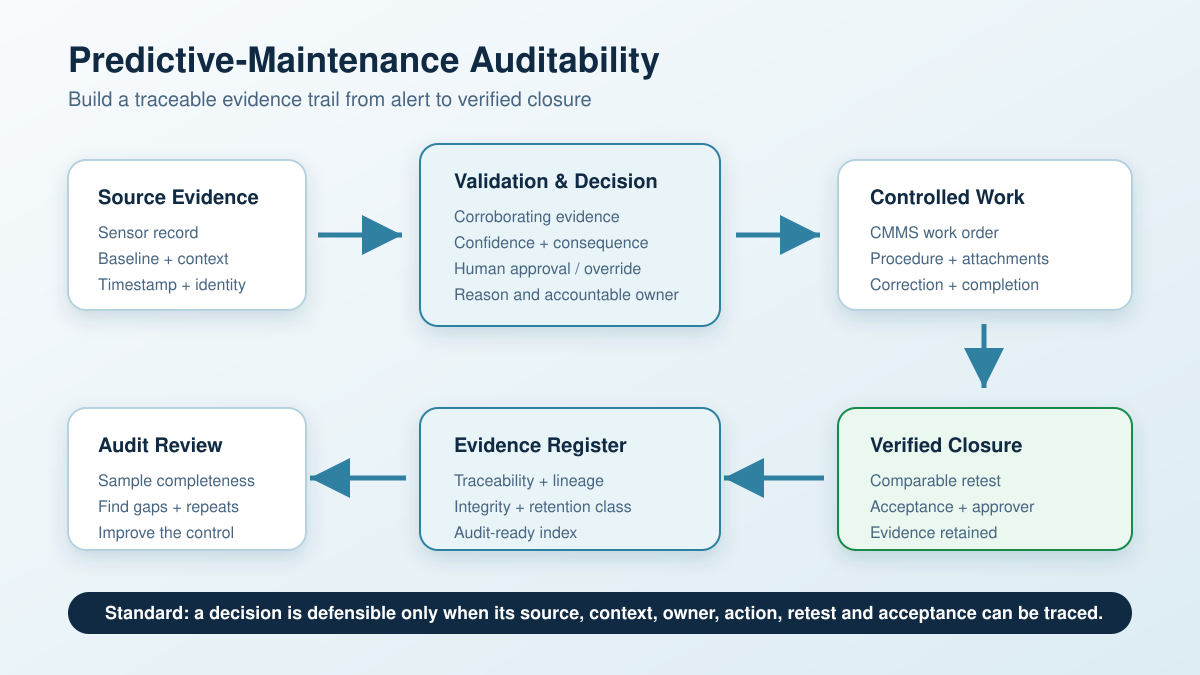
Predictive maintenance becomes trustworthy only when a reviewer can reconstruct the full decision: what condition was detected, which evidence was used, who validated it, why the priority was chosen, what work was completed and whether a comparable retest proved that the risk was removed.
AI data centers generate evidence across sensors, Building Management Systems, Electrical Power Monitoring Systems, condition-monitoring platforms, Data Center Infrastructure Management, Computerized Maintenance Management Systems and human inspections. If those records remain disconnected, the organization may have plenty of data but no defensible evidence trail.
Abbreviation reference
- AI — Artificial Intelligence: Analytical or software methods used to support prediction, classification, prioritization or decision support.
- BMS — Building Management System: Supervisory platform for building services such as cooling and environmental systems.
- EPMS — Electrical Power Monitoring System: Platform for electrical distribution, loading, power quality and related alarms.
- DCIM — Data Center Infrastructure Management: Software connecting facility, asset, capacity and service-dependency information.
- CMMS — Computerized Maintenance Management System: System for assets, work orders, job plans, labor, parts and maintenance history.
- OT — Operational Technology: Systems that monitor or control physical equipment and processes.
- KPI — Key Performance Indicator: A defined measure used to assess performance or control effectiveness.
- OEM — Original Equipment Manufacturer: The equipment manufacturer and source of product-specific requirements.
- SOP — Standard Operating Procedure: Approved instructions for a recurring operational activity.
- MOP — Method of Procedure: Approved step-by-step method for planned technical work.
- EOP — Emergency Operating Procedure: Approved instructions for responding to abnormal or emergency conditions.
Auditability is more than storing attachments
An attachment proves little if its source, time, measurement point and operating condition are unknown. A thermal image without load context cannot be compared fairly with a later scan. A vibration spectrum without measurement direction, running speed or sensor location may not reproduce the original finding. A dashboard screenshot can lose the raw values, rule version and data-quality flags that influenced the alert.
A useful record must preserve meaning, not merely a file. The evidence package should answer six questions:
- Identity: Which asset, component and measurement point does the evidence represent?
- Origin: Which system, instrument or person created it?
- Time: When was it captured, transferred, reviewed and approved?
- Context: What load, configuration, redundancy and environmental conditions applied?
- Integrity: Is the authoritative record retained, protected from uncontrolled change and linked to its version or audit history?
- Decision relevance: How did the evidence support validation, prioritization, work or closure?
Use one case identifier across the control loop
The simplest traceability control is a stable case identifier. It should link the original event, evidence package, validation record, CMMS work order, procedure, corrective-work record, retest and acceptance decision.
The identifier does not require every system to become one database. It requires each system to retain a reliable cross-reference. A reviewer should be able to begin with an alert or work order and navigate both backward to the source evidence and forward to the verified outcome.
Preserve the original evidence before interpretation
Processed charts and analyst notes are useful, but they should not replace the authoritative source. Preserve the original export, scan, waveform, trend or event record whenever the platform permits it. Record the source-system identifier, capture time, timezone, rule or model version and any quality flags.
For high-consequence cases, integrity controls may include controlled repositories, immutable audit history, checksums, access logging or version retention. The level of control should match the consequence and the organization’s approved records policy. Predictive-maintenance evidence is operational evidence; it should not automatically be treated as forensic evidence, but NIST’s chain-of-custody principle is useful when a record may support an incident investigation, contractual review or regulatory inquiry.
Make validation and human overrides visible
A model output is not the final decision. Operators and engineers may raise, lower, defer or reject an alert after considering redundancy, maintenance activity, data quality or additional inspection evidence. That judgment is essential, but it must be reviewable.
Record the original output, human decision, reason, corroborating evidence, accountable approver, time and required follow-up. Repeated overrides of the same rule should trigger a model, threshold or workflow review. An override log protects engineering judgment from becoming an invisible control gap.
Connect work completion to condition resolution
Closing a CMMS task proves that work activity was recorded. It does not prove that the predictive condition was resolved. The work order should link the observed condition to the approved procedure, isolation controls, parts, labor, photographs and completion notes. The evidence trail must then continue to the retest.
If a PDU connection was triggered by thermal differential, scan the same connection under comparable load after correction. If a pump bearing was triggered by vibration, repeat the same measurement point, direction and speed range. If battery impedance drift triggered the work, repeat the measurement with comparable temperature and charger context.
Separate retesting from acceptance
Retesting produces evidence. Acceptance is the accountable decision that the evidence meets the approved criterion. These should be separate fields, even when the same qualified person performs both activities.
- The retest method matches the original measurement method.
- The operating context is sufficiently comparable.
- The acceptance criterion was defined before closure.
- The result and evidence location are recorded.
- An authorized person accepts or rejects closure.
- Any baseline reset is separately reviewed and approved.
Define retention by purpose, not habit
There is no single universal retention period for predictive-maintenance evidence. NIST SP 800-53 treats audit-record retention as organization-defined and aligned with records policy, investigations and applicable requirements. Each organization should set approved retention classes based on operational value, asset lifecycle, warranty, contracts, insurance, incidents, regulation and legal holds.
A routine low-consequence trend may have a different retention need from a critical electrical intervention, a customer-impacting event or evidence subject to investigation. The record should identify the retention class, start event, disposition authority and any hold that suspends normal deletion. Retention decisions should be reviewed with the organization’s records, legal, cybersecurity and risk owners rather than inferred from this article.
Audit a sample, not only the dashboard
A dashboard can show evidence-completeness rates, but periodic sampling tests whether the records are actually usable. Select cases across assets, severities, sites, rules and outcomes. Attempt to reconstruct each case without relying on the original analyst’s memory.
Sample checks should confirm source traceability, decision reasoning, work-order linkage, retest comparability, acceptance authority and retention assignment. Missing evidence should become a corrective action with an owner and due date. Repeated gaps should improve the system design, form requirements, training or integration—not merely the audit score.
Measure evidence health
- Percentage of actionable cases with complete source evidence
- Percentage with full alert-to-closure traceability
- Human overrides with documented reason and approval
- Completed work orders awaiting comparable retest
- Verified closures with an identified acceptance owner
- Missing or inaccessible attachments
- Records without an approved retention class
- Audit samples passed without reconstruction assistance
- Repeated evidence gaps by asset, platform or team
Put this into practice
Use the companion workbook to register evidence, connect identifiers across systems, document validation and overrides, index authoritative attachments, control retest and acceptance, assign retention classes, sample completed cases and report evidence-completeness KPIs.
Download the Predictive-Maintenance Auditability and Evidence Workbook
A biblical perspective on corroborated evidence
“Every matter must be established by the testimony of two or three witnesses.”
— 2 Corinthians 13:1 (NIV)
In its biblical context, this principle concerns establishing a matter fairly rather than accepting an unsupported accusation. It is not a technical maintenance rule, yet it offers a valuable discipline: consequential decisions deserve corroboration. Predictive-maintenance teams should examine multiple credible forms of evidence, preserve the reasoning and avoid treating one unexplained signal as unquestionable truth.
The operating standard
A predictive-maintenance case is audit-ready when an independent reviewer can identify the source evidence, understand the operating context, reconstruct the validation and override decisions, trace the approved work, verify the comparable retest, identify the acceptance authority and confirm that the record is protected for its approved retention period.
Research references
- ISO 55001:2024 — Asset management system requirements for systematic lifecycle, risk, performance and improvement controls.
- ISO 14224:2016 — Structured reliability and maintenance data collection for petroleum, petrochemical and natural-gas equipment; principles are adapted here with its sector scope stated.
- NIST SP 800-82 Rev. 3 — Operational Technology security guidance addressing performance, reliability, safety and security.
- NIST SP 800-53 Rev. 5 — Audit and Accountability controls covering audit-record content, protection and organization-defined retention.
- NIST Chain of Custody glossary — Evidence movement and handling documentation.
- U.S. DOE FEMP Operations and Maintenance Best Practices.
 Data Center Health