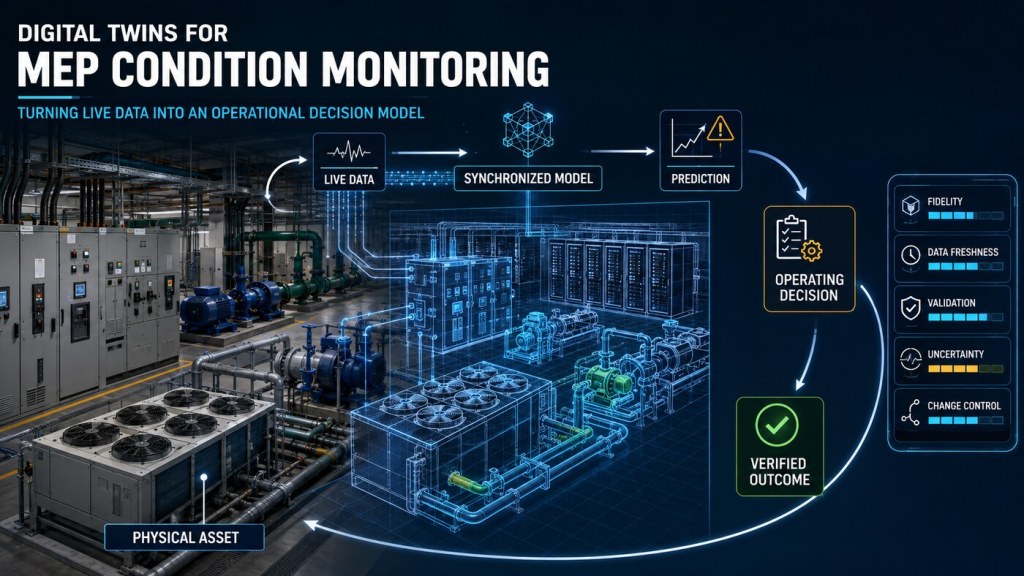
A useful MEP digital twin is not a 3D picture of the facility. It is a synchronized, validated and governed decision model linked to a defined physical system.
The term is ahead of the operating model
Digital twin is now applied to BIM models, dashboards, historians, simulations, analytics platforms and asset registers. Each may be valuable, but none becomes a digital twin merely because it contains a representation of equipment.
NIST describes a digital twin as a particular type of computer model of a physical system, such as a machine or building, with the potential to model system aspects accurately and flexibly. NIST also emphasizes forecasting across digital-twin functions such as simulation, monitoring, optimization and decision support. Its essential-elements guidance describes a successful twin as a dynamic, data-driven virtual representation that connects and synchronizes with its physical counterpart.
For AI hyperscale MEP operations, that creates a practical test: if the model is not tied to a defined physical asset, not synchronized at the cadence required by the use case, not validated for the intended decision or not maintained as the facility changes, it should not be trusted as an operational twin.
What a digital twin is not by itself
- A BIM or 3D model may show geometry and topology but lack live synchronization, condition behavior and prediction.
- A dashboard may display current values without representing system behavior or future state.
- A historian preserves evidence but does not necessarily provide an asset model, prediction or decision logic.
- An analytics model may predict accurately while remaining disconnected from authoritative asset identity, topology or operating state.
- A simulation may represent behavior without being synchronized with the operating facility.
- An alarm rule may detect a threshold without modelling the physical system or its consequences.
A production twin may use all of these components. The distinction is in how they are connected, validated and governed around a specific decision.
Start with the decision—not the model
The safest starting question is: which operational decision should improve?
A bounded MEP use case might be:
- estimate whether a chilled-water pump bearing requires intervention within the next maintenance window;
- prioritize a PDU joint for controlled inspection based on thermal condition, load and power-path consequence;
- identify an underperforming FWU module before the degradation affects rack-inlet temperature;
- test whether a chiller staging strategy will preserve supply temperature during a planned equipment outage; or
- forecast whether current cooling-loop degradation will consume the available redundancy margin.
For each use case, define the physical scope, primary user, time horizon, synchronization cadence, required output, consequence if wrong, human approval requirement, acceptance criterion and value measure. “Create a data-center digital twin” is not a testable use case.
Build six linked layers
1. Physical counterpart and asset identity
Every twin entity should resolve to an authoritative physical asset or system boundary. Record the parent system, location, function, upstream and downstream dependencies, redundancy group, operating states, design value, as-commissioned value and authoritative record.
For a pump train, the twin may need the motor, coupling, bearings, pump, valve state, flow path and power supply. For a PDU risk model, it may need the one-line topology, current operating path, alternate path, breaker state, load and connection-level condition evidence. A generic equipment icon is not enough.
2. Data mapping and synchronization
Trace each twin attribute to the physical measurement point, source system, tag, unit, sampling cadence, source timestamp, transformation, data-quality rule and operating context. The mapping should also define latency and the direction of information flow.
The data-quality and sensor-health controls covered in the previous article remain prerequisites. A twin built on stale, mis-scaled or misidentified signals can be synchronized and still be wrong.
3. Behavioral model
The behavioral layer may be physics-based, data-driven, rule-based or hybrid. The correct method depends on the use case, available evidence and consequence of error. Document the purpose, inputs, outputs, assumptions, training or fit data, known limitations, forecast horizon, uncertainty method and approved operating boundary.
A bearing-condition model may combine vibration features, motor current, speed and load. A thermal model may combine CDU state, flow, supply temperature, rack demand and containment condition. A topology consequence model may combine electrical condition with the currently available redundancy path.
4. Prediction and uncertainty
A prediction should state more than a point result. It should expose confidence, uncertainty, assumptions, data freshness and the conditions under which the output becomes untrusted. Where precise remaining useful life cannot be defended, use a maintenance decision window or low/base/high scenario rather than false precision.
5. Decision and human authority
The twin should route its output into a defined decision process. Record the recommended action, decision owner, actual human decision, override, override reason, work order or operational control, due date and residual uncertainty.
Begin with read-only decision support. A twin that directly changes pumps, breakers, setpoints or cooling sequences crosses into closed-loop control and requires separate operational, cybersecurity, safety, change-control and fail-safe authorization.
6. Verified outcome and learning
The decision record should close the loop: what happened, was the outcome verified, how did the prediction compare with reality, and what should change in the model, baseline, mapping or maintenance strategy?
A twin that never learns from verified outcomes remains a demonstration. The operating model should convert completed interventions, failed predictions, human overrides and asset changes into validation evidence.
Validate the intended decision—not the visual experience
NIST notes that digital twins are challenging to build correctly and identifies standards, interoperability, trustworthiness, verification and validation as important barriers. A visually convincing interface does not validate the twin.
Validation should cover:
- Asset identity: every input and output resolves to the correct physical counterpart.
- Topology: dependencies, redundancy and operating paths match approved as-built conditions.
- Synchronization: twin state follows authoritative sources within the use-case latency requirement.
- Known condition: verified historical or controlled cases produce the expected diagnosis.
- Normal condition: the model does not manufacture faults from valid normal variation.
- Missing or stale data: invalid inputs force a defined untrusted state.
- Operating-boundary test: outputs outside the validated domain are restricted or escalated.
- Uncertainty: confidence behavior is calibrated against actual results.
- Decision performance: the output improves lead time, diagnosis, work planning or risk control without unacceptable noise.
Production-blocking defects should remain visible. A model should not be promoted because most tests passed if the failed test covers topology, asset identity, stale-data behavior or another condition capable of producing a dangerous decision.
Control physical, data and model changes together
A digital twin can drift away from reality even when its algorithm does not change. Construction revisions alter topology. A sensor is replaced. A tag changes. Scaling is corrected. Firmware changes sampling behavior. A baseline is reset after overhaul. An operating sequence is modified.
Change control should therefore cover:
- physical asset and topology changes;
- sensor, tag and transformation changes;
- baseline and operating-state changes;
- model, rule and version changes;
- decision-threshold and workflow changes; and
- cybersecurity, access and interface changes.
Each change should record its reason, affected use cases, risk, required validation, rollback, approval, post-change test and documentation update.
Use standards carefully
ISO/IEC 30173:2023 establishes digital-twin concepts and terminology, including system context, lifecycle processes, functional views and stakeholders. The ISO 23247 series provides a digital-twin framework and reference architecture for manufacturing. Its architecture principles can inform an MEP implementation, but its published scope is manufacturing; it should not be cited as if it were a data-center-specific design standard.
The U.S. Department of Energy’s Virtual EPB project provides a different building-model example: calibrated energy models were developed for defined utility use cases. That demonstrates the value of bounded use cases and calibrated representations, while remaining different from a live equipment-level MEP operational twin.
Download the MEP digital-twin implementation template
The Excel workbook includes use-case definition, physical asset modelling, live-data mapping, model documentation, validation testing, decision and override logging, change control, a readiness dashboard and authoritative source notes.
A biblical perspective on building with understanding
“By wisdom a house is built, and through understanding it is established.”
Proverbs 24:3 (NIV)
This proverb speaks about wisdom and understanding in establishing a household, not about digital engineering. Applied carefully, it offers a useful reminder: a strong operational model is not established by appearance alone. It requires understanding of the real system—its purpose, relationships, limits and consequences. Technology becomes responsible stewardship when it represents reality honestly and supports wise action.
The operational standard
An MEP digital twin is ready for operational use when it is tied to a bounded decision, resolves to the correct physical system, synchronizes trustworthy data at the required cadence, represents relevant behavior and topology, exposes uncertainty, passes use-case validation, preserves human authority and learns from verified outcomes.
The goal is not to build a virtual copy of everything. It is to build the smallest trustworthy model that improves a real maintenance or operating decision—and to keep that model aligned with the facility throughout its life.
 Data Center Health