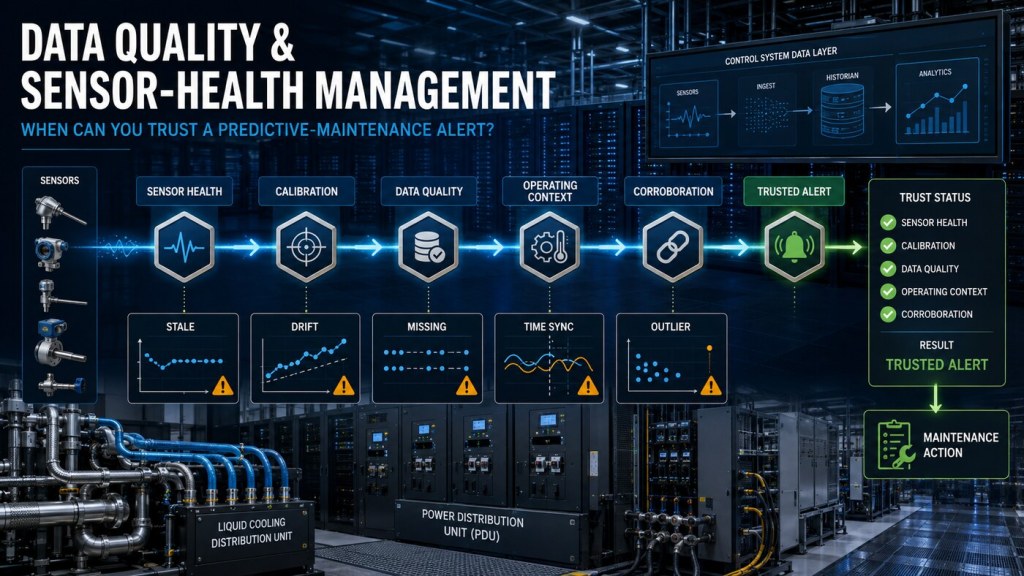
A predictive-maintenance alert is trustworthy only when the measurement device, calibration state, retained data, timestamp, operating context and corroborating evidence are all fit for the decision being made.
A precise algorithm cannot repair unreliable evidence
Predictive maintenance depends on detecting a meaningful deviation from normal condition. If the input is stale, frozen, incorrectly scaled, time-shifted, collected outside calibration status or compared under a different load, the resulting alert may describe the data path rather than the equipment.
This is especially important in AI hyperscale data centers. BMS, EPMS, DCIM, equipment controllers, sensor gateways, historians, analytics platforms and CMMS systems may each hold part of the evidence. A single event can acquire several timestamps, engineering-unit conversions and asset identifiers before it becomes a work order. Every transition creates a chance for context or integrity to be lost.
The correct question is not simply, “Did the value cross the threshold?” It is, “Is this measurement fit to support this maintenance decision?”
Apply five trust gates before promotion
1. Sensor-health gate
Confirm that the device is operating, powered and communicating. Use built-in diagnostics where available, but do not treat a healthy communications status as proof that the measurement is correct. A sensor can transmit a frozen or drifting value perfectly.
Minimum checks include communications, device diagnostic, power or battery state, environmental exposure, signal quality, age of data and a plausibility comparison with previous and peer readings.
2. Calibration and measurement-fitness gate
ISO 10012:2026 specifies requirements for a measurement-management system intended to create confidence in the validity and reliability of measurement results. For predictive maintenance, the practical controls include the measurement purpose, required range and tolerance, calibration or verification status, traceability reference, as-found result, adjustment or repair, as-left result, uncertainty where relevant and the next due date.
An overdue calibration does not automatically prove every historical reading wrong. It does mean the organization must stop treating the evidence as unquestionably fit for purpose. The sensor may need restriction, independent corroboration, recalibration and an impact review covering decisions made since the confirmation status became uncertain.
3. Data-quality gate
For data retained in historians, databases and analytical platforms, ISO/IEC 25012:2008 provides a general model that can be used to define data-quality requirements, measures and evaluations. Its published scope is important: it addresses retained structured data and does not cover real-time sensor data that is not retained for processing or history. In a data center, apply its concepts to the historian and analytical data layer—not as a substitute for measurement-system controls at the physical sensor.
Useful tests include:
- Currentness: is the source timestamp recent enough for the intended decision?
- Completeness: were the expected samples received for the analysis window?
- Validity: is the value within the configured physical and engineering range?
- Consistency: do the unit, scaling, asset identity and related values agree across systems?
- Credibility: is the value plausible against equipment state, peer devices and independent evidence?
- Traceability: can the record be traced to the original device, transformation and reviewer?
4. Time and operating-context gate
A vibration value at full speed is not directly comparable with one captured during ramp-up. A thermal image at 30% load does not establish the same connection condition as a scan at representative load. Battery impedance readings taken with different test methods, temperatures or instrument settings may create an artificial trend.
Record the context that materially changes interpretation: load, speed, equipment mode, command state, redundancy, ambient or fluid temperature, maintenance activity, control sequence and sensor method.
Clock alignment matters for the same reason. If the BMS, gateway, historian, analytics engine and CMMS use different time sources or exhibit excessive offset, the apparent sequence of events may be wrong. Each platform should have an authoritative time source, synchronization method, approved event-correlation tolerance, measured offset, timestamp basis and owner.
5. Corroboration gate
Corroboration asks whether independent evidence supports the proposed failure mode. A bearing-wear alert may combine vibration spectrum, temperature, motor current and acoustic evidence. A degrading PDU joint may combine thermal differential, representative load, sibling comparison and contact-resistance testing. An FWU airflow alert may require module current, command, vibration and rack-inlet response.
Corroboration does not mean every alert needs several sensors. It means the evidence requirement should match the consequence, confidence and accessibility of the failure mode. High-consequence action based on one weak data source requires more scrutiny than a low-risk observation.
Detect the failure patterns that masquerade as equipment degradation
Stale data
The displayed value may look reasonable while the source timestamp has stopped advancing. Test age from the source timestamp—not only the platform receipt time—and compare it with the expected sampling interval.
Frozen data
A value can continue arriving with new timestamps while remaining exactly unchanged. Detect repeated values over a physically implausible duration, especially when the equipment state or peer readings are changing.
Missing samples
Trend analysis can remain visually smooth after interpolation or aggregation hides gaps. Record expected and received samples, identify transformations and reduce confidence or reject the window when completeness falls below the approved requirement for that use.
Outliers and scaling errors
Physical-range, engineering-range, rate-of-change and peer-comparison tests catch impossible values, unit conversion problems and abrupt scaling changes. Do not automatically delete an outlier: it may be the earliest valid indication of failure. Preserve the raw record and classify the reason for exclusion or escalation.
Sensor drift
Slow drift is difficult because it resembles equipment degradation. Compare the sensor with a reference, redundant measurement, peer asset, known process relationship or portable instrument. A persistent deviation against peers while the equipment performance remains stable points toward the measurement path; corroborating process degradation points back toward the asset.
Manual and substituted data
Manual entries and substituted values should carry source, author, time, reason, approval and intended use. They should not enter an automated predictive model invisibly. Provenance must remain available to the reviewer and downstream audit.
Separate data incidents from equipment failures
A stale gateway, expired calibration, broken asset mapping or clock offset is a data incident. It may create operational risk, but it is not evidence that the monitored asset failed. Logging data incidents separately prevents false maintenance history from contaminating future models and reliability analysis.
Each data incident should record the affected sensor and period, affected alerts or models, containment, root cause, correction, owner, verification and recurrence check. After correction, reconsider any alert, work order, baseline or model output that relied on the suspect period.
NIST SP 800-82 Rev. 2 addresses industrial-control-system security while recognizing OT performance, reliability and safety requirements. The NIST NCCoE work on protecting ICS information and system integrity further reinforces the need to protect transmitted and system data. These are security references, not calibration standards; they complement the measurement and data-quality controls by addressing the integrity of the OT path.
Use confidence as a decision aid, not a disguise
A simple trust-gate score can make reviews consistent, but it should not average away a mandatory failure. For example:
- Trusted alert: all required gates pass and the failure mode is actionable.
- Observation only: evidence is credible but not yet sufficient for work.
- Hold: a correctable evidence gap prevents the decision.
- Rejected data: the record is not fit for the intended conclusion.
- Escalate: uncertainty remains, but consequence requires immediate human review or protective action.
Safety and protection logic should continue to follow approved control-system design and procedures. The trust-gate method governs predictive-maintenance evidence; it should not be used casually to suppress a protective alarm.
Download the data-quality and sensor-health template
The Excel workbook includes a sensor register, calibration register, objective data-quality rules, sensor-health checks, trust-gate alert validation, time-synchronization tracking, data-incident management, a dashboard and authoritative source notes.
A biblical perspective on listening before deciding
“To answer before listening—that is folly and shame.”
Proverbs 18:13 (NIV)
This proverb concerns wise listening and human judgment, not sensor engineering. Applied carefully, it offers a fitting reminder: reaching a conclusion before hearing the evidence is not wisdom. In predictive maintenance, responsible stewardship means listening to the full record—the sensor’s condition, calibration, timestamp, operating context and corroborating evidence—before committing people, equipment or service risk to a decision.
The trust standard
A predictive-maintenance alert is ready for action when the measurement is fit for purpose, the sensor and data path are healthy, the retained data is suitable for analysis, time and operating context are comparable, the proposed failure mode is corroborated and the decision preserves its evidence and uncertainty.
The best model cannot compensate for evidence the organization has not proved trustworthy. Sensor-health and data-quality management are therefore not support functions around predictive maintenance. They are part of the maintenance control loop itself.

