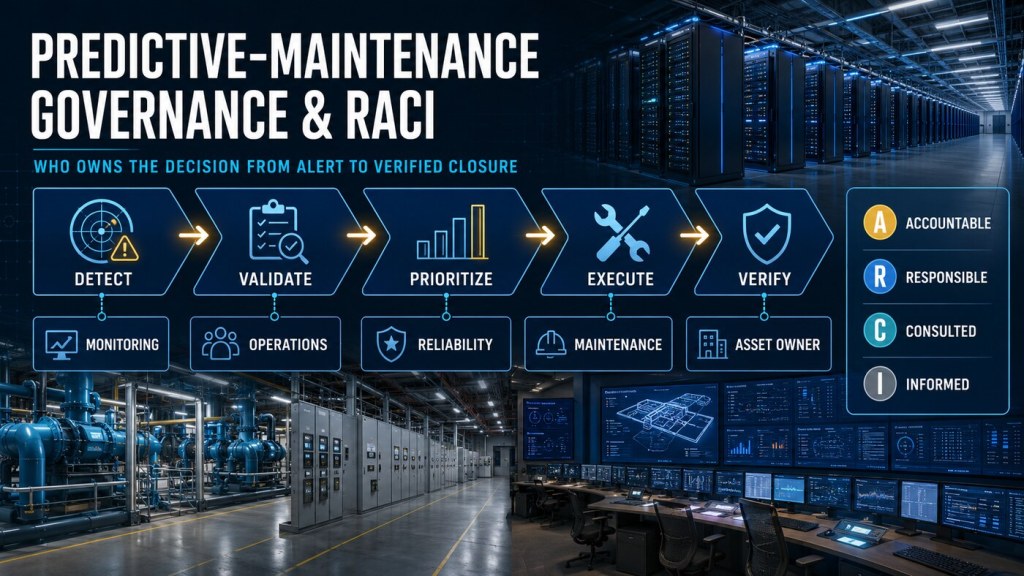
Predictive maintenance fails operationally when everyone can see the alert but nobody clearly owns the decision to validate it, prioritize it, act on it and accept the repair.
The ownership gap sits between the dashboard and the work order
A monitoring platform can detect vibration drift, battery impedance rise, a thermal differential or deteriorating airflow. That does not answer the operational questions that follow:
- Who decides whether the signal is credible?
- Who checks the operating context and redundancy?
- Who assigns the failure consequence and response time?
- Who may defer the intervention and accept the resulting risk?
- Who approves the method and performs the work?
- Who retests the original condition?
- Who has authority to declare the case verified and closed?
When these decision rights are left implicit, the alert moves between monitoring, operations, engineering, maintenance, vendors and management without becoming an accountable action. A RACI matrix can help, but only when it is tied to actual authority, competence, evidence and escalation—not used as a decorative project document.
Govern the complete control loop
ISO 17359:2018 provides general procedures for establishing a condition-monitoring program. ISO 55001:2024 provides requirements for establishing, implementing, maintaining and improving an asset-management system, with a lifecycle focus on value, risk, performance and expenditure. The practical implication for an AI data center is that predictive monitoring cannot be governed as an isolated sensor project. It must sit inside the facility’s asset-management and work-control system.
The governed sequence is:
- Detect: create a traceable observation from valid condition evidence.
- Validate: confirm data quality, operating context, baseline deviation and credible failure mode.
- Prioritize: assess consequence, redundancy, affected service, urgency and compensating controls.
- Execute: plan and perform approved work using the correct MOP, permits, competence and OEM limits.
- Verify: retest the original condition under comparable circumstances and decide whether the acceptance criterion was met.
- Learn: update the case record, baseline, rule, maintenance strategy and benefit classification.
RACI is a decision map, not a staffing chart
For each material activity:
- Accountable means one role owns the outcome and final decision.
- Responsible means the role performs the work or produces the evidence.
- Consulted means specialist input is required before the decision.
- Informed means the role receives the result but does not hold up the workflow.
The most important rule is simple: assign exactly one accountable owner to each decision. Multiple responsible roles may contribute, but multiple accountable roles usually mean no single person has accepted the decision.
RACI also does not create technical authority. A person marked accountable for a switchgear decision still needs the site’s authorization, competence and work-control approval. The matrix must be read alongside switching rules, permit-to-work controls, MOP/EOP approval, cybersecurity change control and OEM restrictions.
A workable role model for AI hyperscale operations
Monitoring or analytics
Owns signal collection, data-quality status and creation of the initial observation. It should not automatically own the maintenance consequence decision, especially where a platform vendor or data team lacks live knowledge of facility topology and redundancy.
Operations
Owns current operating context: load, redundancy, active maintenance, alarms, temporary controls and immediate protection of service. Operations may apply approved EOP or MOP actions, but an emergency operational response is not the same as accepting permanent technical closure.
Reliability engineering
Owns technical validation of the condition, diagnosis of the likely failure mode, comparison with the known-good baseline and recommendation of the intervention and retest criterion. Where OEM expertise is needed, Reliability remains responsible for integrating that advice into the facility decision.
Maintenance planning and execution
The planner converts the approved need into labor, parts, method, permits and schedule. Maintenance or the OEM performs the work and records the as-left state. The person executing the repair should not be the only person deciding that the original condition has been technically cleared.
Asset owner
Owns the lifecycle consequence, priority exceptions, deferral, residual-risk acceptance and final closure decision. This does not mean the asset owner personally performs every review. It means delegated authority is explicit, bounded and traceable.
IT/OT platform owner
Owns system identity, access, integration, time synchronization, rule deployment, audit logging, data retention and cybersecurity controls. NIST’s Cybersecurity Framework 2.0 states that roles, responsibilities and authorities should be established and communicated to support accountability and continuous improvement. Although CSF 2.0 is a cybersecurity framework, that governance principle is directly relevant to condition-monitoring platforms connected to BMS, EPMS, DCIM and CMMS environments.
Put decision rights beside the RACI
A RACI letter alone does not state what a person may decide. A separate decision-rights register should define:
- the exact decision;
- the named decision owner and permitted delegate;
- required consultation;
- the trigger, threshold and time limit;
- minimum evidence;
- delegation limits;
- the exception and escalation route; and
- the approval and review date.
For example, an Operations shift lead may have immediate authority to reduce load or start standby equipment under an approved procedure. The same role may not have authority to defer a critical bearing repair for 30 days. That decision belongs with the asset owner and should include Reliability, Operations and Risk input, compensating controls and a defined expiry.
Treat alert rules as governed assets
Every production rule should have a rule owner, validation owner, priority owner, persistence requirement, deduplication window, maintenance suppression logic, data-quality gate, work-order rule, retest criterion, review cadence and retirement condition.
A threshold change can alter maintenance workload and operational risk. It should therefore follow controlled change management with documented rationale, validation data, impact assessment, approval, deployment record and rollback. The IT/OT owner controls the platform change; Reliability owns the technical interpretation; Operations confirms the operational impact.
Work complete is not verified closed
This is the governance boundary most likely to be lost under schedule pressure. A technician can correctly complete the assigned work, attach photographs and close the labor task. The predictive-maintenance case should remain open until the original condition has been retested against its acceptance criterion.
Verified closure should record:
- the original failure mode and acceptance criterion;
- the work performed and completion evidence;
- the independent or competent retest owner;
- the comparable operating context;
- the retest result;
- residual risk and temporary monitoring;
- whether the baseline or rule must be updated; and
- the closure approver.
Use governance reviews to resolve exceptions
A monthly predictive-maintenance governance review should focus on decisions, not dashboard presentation. Review critical and overdue cases, conditions awaiting validation, interventions awaiting retest, expiring deferrals, rule changes, duplicate and false-positive trends, unresolved ownership gaps and benefit claims requiring independent review.
The forum should record each decision, action owner, due date, escalation and evidence reference. A governance meeting without an action register simply relocates the ambiguity from the dashboard to the minutes.
Download the governance and RACI template
The Excel workbook includes a role register, RACI matrix, decision-rights register, alert-rule governance, escalation matrix, closure-verification log, governance-review actions, dashboard and source register.
A biblical perspective on orderly responsibility
“But everything should be done in a fitting and orderly way.”
1 Corinthians 14:40 (NIV)
Paul’s instruction was given in the context of orderly worship, not maintenance governance. The principle should therefore be applied with care rather than presented as a technical command. It still offers a useful reflection: good stewardship does not depend on confusion, hidden authority or improvised responsibility. Order supports service when people understand their role, act within their authority and remain accountable for the outcome.
The governance standard
A predictive-maintenance program is governed when every material alert enters a known decision path; each decision has one accountable owner; authority and competence are explicit; deferrals are time-bounded; platform changes are controlled; work completion is separated from technical verification; and the final record shows who accepted the outcome and why.
The objective is not to make the workflow bureaucratic. It is to remove the ambiguity that allows credible evidence to sit unowned until the condition becomes an incident.

