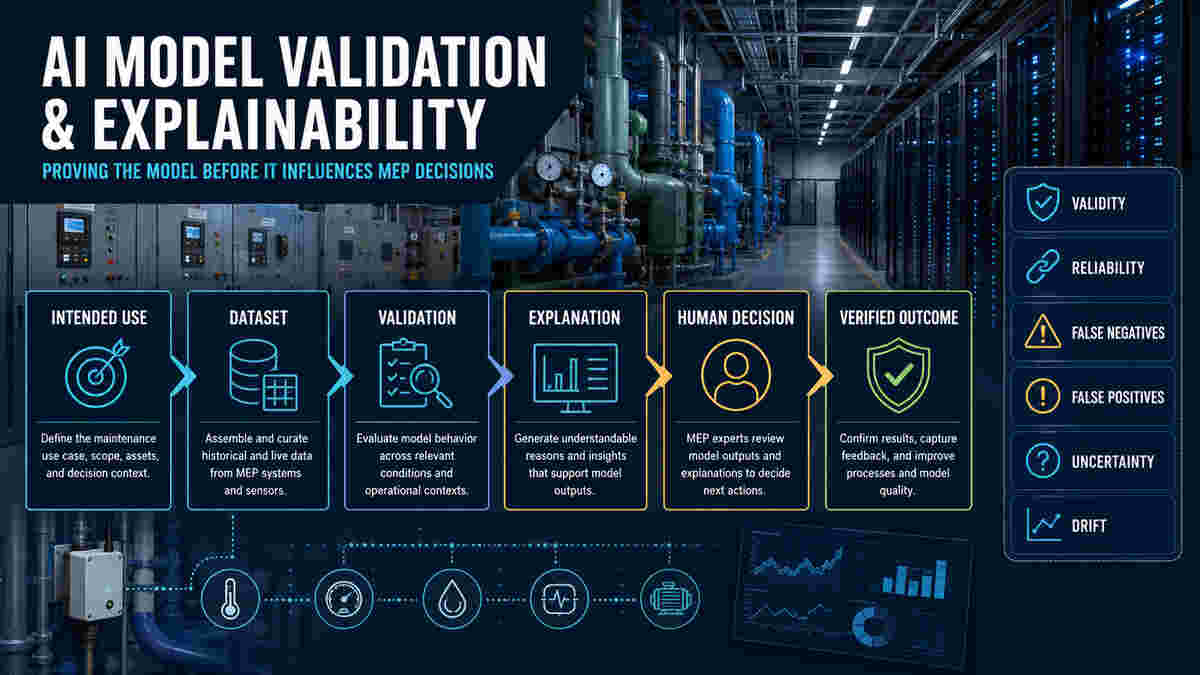
A model that predicts a failure is useful only if the team can prove what it was built to do, where it stops being trustworthy, and how a human turns its output into a controlled maintenance decision.
Why a high accuracy score is not enough
In an AI hyperscale data center, model error is not an abstract statistical issue. A false negative can leave a developing cooling, power, or rotating-equipment fault untreated until redundancy is lost. A false positive can create unnecessary inspections, maintenance churn, and alarm fatigue. The two errors do not carry the same operational consequence, so a single aggregate accuracy score cannot establish that a model is safe for a particular MEP decision.
Aggregate scores can also hide weak performance in the conditions that matter most: rare failure classes, startup and transfer events, high-load periods, recently serviced assets, or equipment families with little historical data. Validation therefore begins with the intended decision and its consequence—not with the algorithm or dashboard.
Start with intended use and a hard decision boundary
Before testing the model, write down exactly what it is allowed to influence. The intended-use statement should name the assets, users, prediction horizon, operational context, output, and decision the model supports. It should also state prohibited uses.
- Asset scope: the specific UPS strings, chillers, pumps, fan modules, PDUs, or switchgear populations covered.
- Decision supported: inspect, collect another measurement, prioritize a work order, or schedule a controlled intervention.
- Prediction horizon: the period in which the forecast is expected to remain actionable.
- Operating envelope: loads, modes, environmental ranges, firmware versions, and sensor configurations represented in validation.
- Prohibited action: no automatic switching, shutdown, protection-setting change, or maintenance deferral unless a separately engineered and approved control case exists.
For most maintenance applications, the safe starting posture is advisory: the model prioritizes evidence for a qualified person, while approved MOPs, EOPs, protection logic, and operating authority remain in control.
Lock the dataset—and prevent leakage
A model cannot be validated independently of the data used to build and test it. Training, validation, and final test datasets should be versioned and separated. Where time and asset history matter, the split should prevent future information, duplicated events, or closely related records from leaking into the test set.
- Confirm that failure labels are supported by inspections, work orders, test results, or other traceable evidence.
- Document missing data, sensor substitutions, timestamp alignment, maintenance resets, and changes in asset configuration.
- Check representation across equipment types, operating modes, load bands, seasons, and known failure modes.
- Keep a final holdout dataset that was not used for feature selection, tuning, or threshold setting.
- Record provenance, owner, approval status, retention rules, and limitations in a dataset register.
Rare failures create a particular trap: a model can appear highly accurate by predicting “healthy” most of the time. That is why class-specific performance and event-level review matter more than a flattering headline metric.
Translate the confusion matrix into operational risk
Every classification model produces true positives, false positives, true negatives, and false negatives. The validation team should translate each category into a site consequence and assign an owner for accepting or reducing that risk.
- False negative: a developing fault is missed. Review the consequence to safety, capacity, redundancy, SLA exposure, and time to recover.
- False positive: a healthy asset is flagged. Review inspection burden, unnecessary switching or access, spare consumption, and alarm fatigue.
- True positive: confirm that the alert arrived early enough and included enough evidence to support useful action.
- True negative: confirm that the model was tested across the full approved operating envelope, not only stable normal operation.
Acceptance limits should be site-approved and tied to consequence. They should be reported by asset family and operating regime, with confidence intervals or other uncertainty information where appropriate. There is no responsible universal threshold that applies to every MEP system.
Calibration, uncertainty, and the right to abstain
A confidence score should mean something observable. If alerts labelled 80% confidence do not correspond approximately to that level of observed outcome under the validated conditions, the score can mislead operators even when the ranking is useful.
The system also needs an abstention state. Stale inputs, failed sensors, missing channels, out-of-range operating conditions, unrecognized equipment, or material data drift should produce untrusted/no recommendation—not a confident-looking prediction built from invalid evidence. Safe uncertainty handling is a functional requirement, not a cosmetic disclaimer.
Explainability that an operator can use
An explanation is useful only when it supports review and challenge. A maintenance alert should show enough evidence for an MEP specialist to understand why it was raised and what the model does not know.
- A clear reason code and the asset or component affected.
- The sensor signals, derived features, or trend changes that materially influenced the output.
- Comparison with the asset’s known-good baseline and, where appropriate, comparable peer equipment.
- Load, mode, environmental context, data freshness, and sensor-health status.
- Uncertainty, known limitations, and whether the case is inside the validated operating envelope.
- A recommended next check and an explicit statement of actions the model is not authorized to take.
A plausible narrative is not automatically a faithful explanation. Explanation methods should be tested for stability and consistency, and their output should be compared with known engineering relationships and deliberately constructed cases.
Run in shadow mode before operational influence
Before a model prioritizes live work, run it in shadow mode: generate predictions without changing maintenance priorities, then compare them with inspections, work orders, failure investigations, and operator judgment. This exposes workflow problems that offline testing misses—late alerts, duplicated notifications, poor reason codes, weak sensor coverage, and predictions that are statistically correct but operationally useless.
Move from shadow mode to a limited pilot only after agreed gates are met. Require human review, capture overrides and reasons, and define an immediate rollback path. Expanding to production should be a controlled approval decision, not a silent configuration change.
Monitor drift and place every change under control
Validation does not end at deployment. Asset aging, sensor replacements, firmware updates, control-sequence changes, maintenance interventions, and load-profile shifts can all change the relationship between inputs and failure risk.
- Input drift: the distribution, range, or missingness of sensor data changes.
- Performance drift: confirmed outcomes no longer match the validated error profile.
- Concept drift: the relationship between measured condition and failure changes.
- Operating-domain drift: the facility begins using the model on assets or conditions outside its approved scope.
- Sensor-health drift: calibration, mapping, sampling, timestamps, or data quality degrade.
Retraining, feature changes, threshold changes, sensor remapping, topology changes, and material firmware or control changes should create a new model version with documented impact assessment and proportionate retesting. A model that changes without a controlled record is no longer the model that was approved.
Build a model assurance record
The durable deliverable is not the scorecard—it is the evidence chain. Maintain a model register, dataset register, validation plan, test results, explainability review, drift record, decision and override log, and change-control history. Together they answer the questions operators, engineering leaders, auditors, and incident investigators will ask: what was approved, on what evidence, for which use, under which limitations, and what changed afterward?
Download the AI Model Validation & Explainability Workbook
Use the 11-sheet Excel guide to define intended use, register models and datasets, plan validation tests, record pass/fail evidence, review explanations, monitor drift, document human decisions, control changes, and track readiness on a dashboard. The example entries and thresholds are illustrative—replace them with values approved for your assets, risk classification, and operating procedures.
A short biblical reflection
“but test them all; hold on to what is good”
1 Thessalonians 5:21 (NIV)
In its original context, this verse concerns spiritual discernment; it is not an engineering standard. Applied carefully by analogy, it encourages a disciplined habit: do not trust a claim merely because it sounds authoritative. Test it, retain what evidence supports, and reject what is unsafe or unproven. That posture fits responsible AI assurance—especially before a model can influence decisions affecting people, equipment, and uptime.
Research and standards context
This article uses the following current primary references as governance and assurance context. They do not create data-center-specific acceptance thresholds; those remain the responsibility of the facility owner and qualified engineering teams.
- NIST AI Risk Management Framework 1.0 — a voluntary framework organized around Govern, Map, Measure, and Manage. NIST notes that a revision of AI RMF 1.0 is underway.
- NIST AI RMF trustworthy and responsible AI characteristics — including validity and reliability, safety, transparency, explainability, and accountability.
- NIST AI RMF Playbook — suggested actions supporting use of the framework.
- NIST AI Metrology — measurement and evaluation work for trustworthy AI.
- ISO/IEC 42001:2023 — requirements for an AI management system and continual improvement.
- ISO/IEC 23894:2023 — guidance on AI risk management.
- ISO/IEC TR 24028:2020 — an overview of trustworthiness in AI.
- 1 Thessalonians 5:21 (NIV).
The control principle
A predictive model should earn influence progressively. Define its use, validate representative evidence, expose uncertainty, make the reasoning reviewable, run it in shadow mode, preserve human authority, and monitor the deployed system for change. The objective is not to prove that a model is universally correct. It is to prove that a specific version is sufficiently trustworthy for a specific, bounded maintenance decision—and to stop relying on it when that proof no longer holds.
Next in the series: designing a model-monitoring and retraining cadence without turning drift alerts into another source of operational noise.

