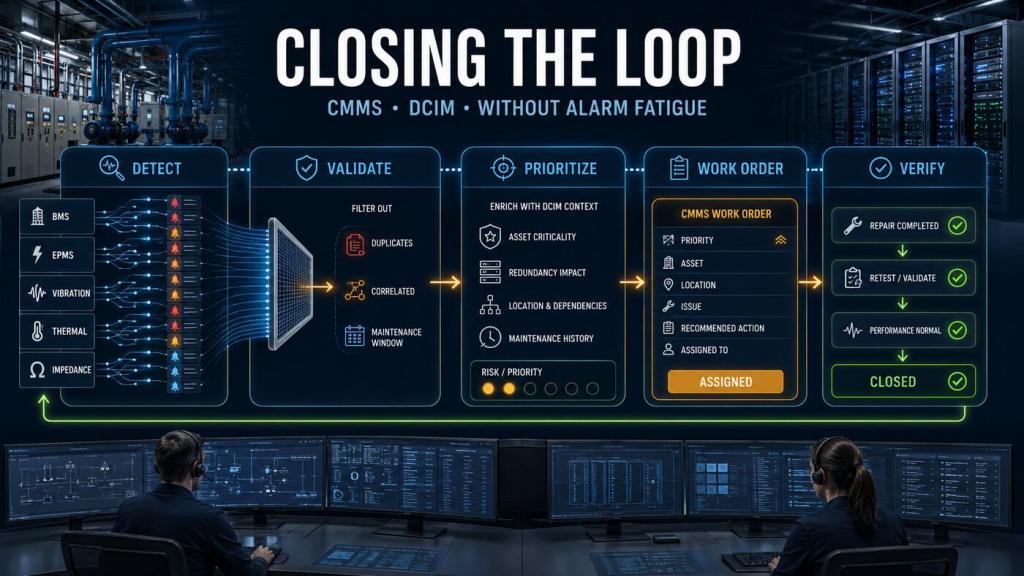
Predictive maintenance creates value only when a credible equipment warning becomes an owned, prioritized and verified maintenance action—not another alert left unattended on a dashboard.
The sensor is only the beginning
Installing vibration, thermal, impedance, water-quality and power-monitoring sensors does not create a predictive-maintenance program by itself. Sensors create observations. The maintenance program begins when those observations are interpreted in context, converted into decisions and routed to people who can act on them.
This is where many programs lose effectiveness. The facility may have comprehensive instrumentation, but the data remains divided among specialist platforms:
- BMS monitors cooling and environmental conditions.
- EPMS monitors electrical performance and loading.
- DCIM connects infrastructure conditions to racks, rooms and capacity.
- Specialist platforms analyze vibration, battery impedance, oil samples or thermal images.
- CMMS manages inspections, work orders, labor, spare parts and maintenance history.
If these systems operate as separate destinations, technicians must manually compare several dashboards before deciding whether an alert deserves action. At AI-hyperscale scale, that approach does not remain manageable for long.
The objective is not to send every sensor alarm into the CMMS. It is to create a controlled path that converts validated maintenance risk into actionable work while suppressing noise, duplication and low-confidence findings.
Give each platform a defined role
Alarm fatigue often begins when multiple systems try to perform the same function. A clean operating model gives each platform a specific responsibility.
BMS and EPMS provide operational evidence. They show current equipment state, alarms, loading, temperatures, pressures, flows, power quality and environmental conditions.
Specialist condition-monitoring platforms provide failure-mode analysis. They detect changes such as bearing-frequency development, battery-impedance drift, thermal anomalies or lubricant contamination.
DCIM supplies operational context. It connects the affected infrastructure to the data halls, racks, customers, IT loads and redundancy paths that depend on it.
CMMS controls the maintenance response. It records the work request, priority, owner, procedure, parts, evidence, completion and retest result.
The systems do not need to duplicate one another. They need to exchange enough information for an alert to move through a single accountable control loop.
Not every alert should become a work order
Automatically creating a CMMS work order from every threshold crossing is one of the fastest ways to produce alarm fatigue. Short-lived excursions, sensor faults, maintenance activity and repeated notifications can create hundreds of low-value tickets that obscure the few conditions requiring intervention.
A better model uses three stages.
Stage 1: detect
The source system identifies a change against an approved baseline or condition criterion. Examples include:
- Increasing vibration at a specific FWU fan module
- UPS battery impedance drifting across successive readings
- A PDU connection becoming warmer than comparable loaded phases
- Cooling-tower approach temperature rising alongside deteriorating basin chemistry
- A chiller refrigerant or lubricant condition moving away from its known-good state
At this stage, the system has detected an observation—not necessarily a failure.
Stage 2: validate
The observation is checked against operating context and corroborating evidence. Validation should answer questions such as:
- Was the equipment operating under a representative and comparable load?
- Is the sensor healthy and was the measurement method consistent?
- Did the condition persist beyond an approved duration?
- Is the same event already open?
- Does a second data source support the finding?
- Is planned maintenance, testing or switching activity responsible for the change?
- What equipment, rack row or customer load depends on the affected asset?
A thermal anomaly without load context may be misleading. A vibration increase during an operating-speed change may not represent degradation. A cooling alarm during an approved functional test should not create an unplanned corrective work order.
Validation is what separates useful predictive evidence from alarm noise.
Stage 3: act
Only after validation should the event become a CMMS notification, inspection request or corrective work order. The work item must contain enough evidence for the assigned team to act without reconstructing the entire analysis.
This detect–validate–act structure allows automation without surrendering engineering judgment.
Use confidence, consequence and urgency together
Sensor severity alone is not enough to determine maintenance priority. A useful prioritization model combines three dimensions:
- Confidence: How reliable and corroborated is the finding?
- Consequence: What happens if the affected component fails?
- Urgency: How quickly is the condition changing or approaching an approved limit?
A high-confidence warning on a redundant, non-critical fan may justify a planned work order. A moderate-confidence warning on the only available cooling path serving a high-density AI row may require immediate investigation because the consequence is much greater.
A practical decision matrix could classify validated events as:
- Critical: Immediate operational risk, rapidly worsening condition, insufficient redundancy or direct threat to protected load
- High: Credible degradation requiring prompt planned intervention
- Medium: Developing condition requiring increased monitoring or scheduled inspection
- Low: Informational trend retained for history but not yet requiring maintenance work
The priority should be recorded with its reasoning. Operators must be able to understand why the same sensor severity can produce different maintenance responses on different assets.
Control alarm fatigue before it reaches the CMMS
Alarm fatigue is not solved by asking technicians to pay more attention. It is solved through better event design.
Deduplicate repeated events
Multiple notifications from the same asset, failure mode and time window should update one active event instead of creating separate work orders. A worsening condition should increase the priority or append new evidence to the existing record.
Apply persistence rules
A brief transient should not automatically become maintenance work unless that transient itself represents a critical failure mode. Persistence criteria can require the condition to remain present for a defined duration or recur a defined number of times.
Suppress alerts during approved work
Maintenance, commissioning, transfer testing and controlled equipment shutdowns can generate expected alarms. Approved suppression windows should prevent these from becoming false corrective work while preserving the underlying event history for audit purposes.
Correlate dependent alarms
A degraded FWU module may cause an airflow alarm, motor-temperature warning and rack-inlet temperature rise. These should be correlated as evidence of one developing equipment condition—not treated as three unrelated failures.
Close the feedback loop
If technicians repeatedly classify a particular alert as non-actionable, the rule should be reviewed. If an incident occurs without an earlier actionable warning, the sensor coverage, thresholds and validation logic should also be reviewed.
Alarm performance must be maintained like the physical equipment it protects.
What the CMMS work order should contain
A predictive-maintenance work order needs more structure than a conventional alarm-generated ticket. At minimum, it should include:
- Asset and component identifier
- Exact measurement point
- Detected failure mode or condition
- Current value, baseline and rate of change
- Load and operating conditions
- Corroborating evidence
- Data-quality and confidence rating
- Criticality and affected service
- Available redundancy
- Recommended action and required response time
- Applicable SOP, MOP, EOP or OEM procedure
- Required permits, isolation and safety controls
- Required tools, parts and vendor support
- Retest and acceptance criteria
- Links to source-system evidence
The work order should tell the technician what was observed, why it matters and how successful restoration will be demonstrated.
Retesting is what closes the predictive loop
Completing the physical repair is not the same as resolving the condition. The asset should be tested against the same evidence that triggered the work.
If a PDU connection was flagged by thermal differential, the repaired connection should be rescanned under a comparable load. If a fan bearing was flagged through vibration, the same measurement point, direction, speed and method should be used after repair. If cooling-tower performance was identified through approach temperature and basin chemistry, both should be reviewed after corrective treatment.
The CMMS work order should not close until:
- The corrective work is documented.
- The original condition is retested.
- The result meets the approved acceptance criterion.
- Supporting evidence is attached.
- Any baseline reset is reviewed and authorized.
- Monitoring frequency returns to normal or remains elevated with a defined reason.
Without retesting, the program records activity but cannot demonstrate that the risk was removed.
Measuring whether the integration is working
The program should track operating-quality metrics, not merely the number of alerts generated. Useful measures include:
- Percentage of alerts automatically deduplicated
- Percentage of alerts validated as actionable
- False-positive and invalid-data rates
- Time from detection to validation
- Time from validation to work-order assignment
- Percentage of critical findings with an assigned owner
- Percentage of completed work orders with retest evidence
- Repeat-alert rate after corrective maintenance
- Number of failures detected before service impact
- Planned versus emergency maintenance resulting from predictive findings
A rising number of alerts is not necessarily evidence of a better program. A lower volume of higher-confidence, properly closed actions is usually more valuable.
Put this into practice
Download the AI Hyperscale Predictive-Maintenance CMMS/DCIM Integration Template to map sensor sources, define validation and suppression rules, score confidence and consequence, route approved events into work orders, track response times and verify closure through retesting.
A biblical perspective on orderly execution
“But everything should be done in a fitting and orderly way.”
1 Corinthians 14:40 (NIV)
Predictive maintenance creates value through orderly execution. Information must be validated, prioritized, assigned and carried through to verified closure. When alerts are allowed to accumulate without ownership or discipline, even good technology becomes noise. A fitting and orderly process turns early warning into responsible stewardship of the people, equipment and services entrusted to the operations team.
What comes next
The next article will examine how to measure the financial and operational value of the completed control loop: avoided downtime, reduced emergency work, better use of labor and spares, extended asset life and lower operational risk.
Predictive maintenance should not be measured by how many sensors were installed or how many alerts were generated. It should be measured by whether credible evidence reached the right owner early enough to prevent an incident—and whether the organization can prove that the risk was removed.

