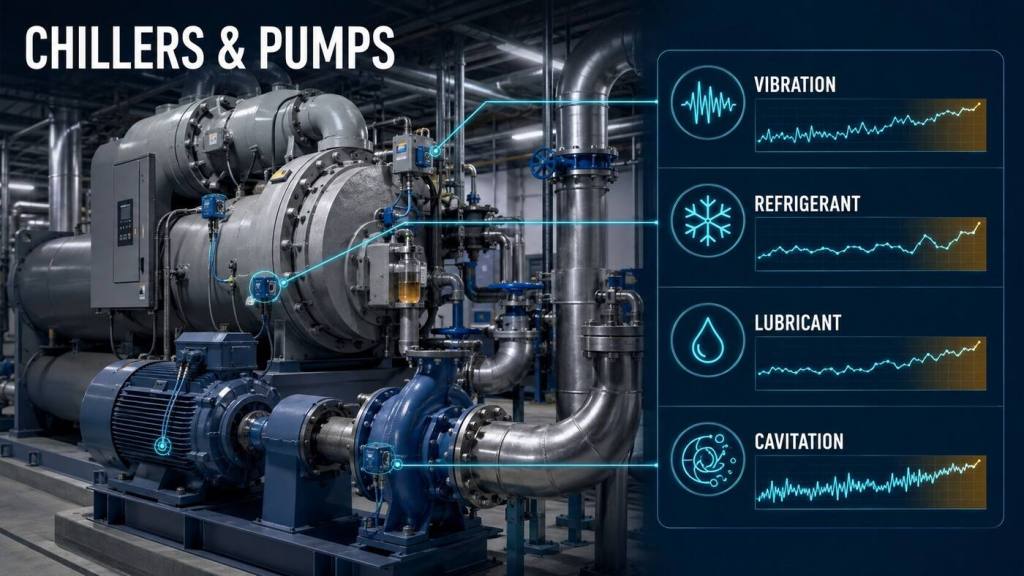
Vibration signatures and refrigerant trending turn a chiller trip from a surprise into a scheduled repair.
Rotating equipment fails mechanically, before it fails electrically
Chillers and pumps share a failure profile: they’re built around rotating components — compressors, motors, impellers, bearings — that degrade mechanically long before that degradation shows up as an electrical fault or a performance drop the building management system would flag. By the time a chiller trips on a fault code or a pump’s flow rate visibly drops, the mechanical degradation driving it has usually been developing for months.
Vibration analysis and refrigerant (or lubricant) trending exist to close that gap — surfacing the mechanical degradation while it’s still developing, not after it’s caused a stoppage.
Vibration analysis: what the signature tells you
A vibration sensor doesn’t just detect “something is wrong” — the frequency pattern of the vibration signature indicates which specific failure mode is developing, which is what makes it useful for scheduling rather than just alerting:
- Imbalance shows up as vibration at the rotational frequency itself, typically from a fouled impeller, debris buildup, or wear on the rotating assembly.
- Misalignment between motor and pump or compressor shafts shows up as vibration at twice the rotational frequency, often developing gradually as mounting hardware loosens or foundations settle.
- Bearing wear produces higher-frequency vibration patterns specific to the bearing’s internal geometry, and the progression through early-stage to severe bearing wear is well-documented enough that vibration data can estimate remaining useful life, not just flag current condition.
- Looseness — a mounting bolt backing out, a coupling wearing loose — produces a broader, less clean vibration signature that’s often the earliest sign something needs physical inspection.
Establishing a baseline vibration signature at commissioning or immediately after a major service is what makes this data predictive rather than just descriptive — subsequent readings are compared against that specific machine’s known-good signature, not a generic industry threshold.
Refrigerant and lubricant trending
For chillers specifically, refrigerant charge level and oil condition provide a second, independent data source. Gradual refrigerant loss from a slow leak reduces cooling capacity long before it triggers a low-charge fault, and tracking charge level over time catches the leak while it’s still a minor loss rather than a capacity crisis during peak thermal load. Oil analysis — moisture content, acid number, particle count — reveals compressor wear and contamination that vibration alone won’t show, since the oil is carrying physical evidence of wear from surfaces vibration sensors can’t directly monitor.
For pumps, lubricant analysis on the motor and bearing housing plays a similar role, and cavitation — a common pump failure precursor caused by pressure drops in the fluid — has its own distinct vibration and acoustic signature separate from the mechanical wear patterns above.
Why AI hyperscale load profiles make this more urgent
Chillers and pumps in AI hyperscale facilities run closer to continuous full load than in traditional data halls, with less idle time for a problem to reveal itself gradually without consequence. A chiller operating at high utilization has less thermal margin to absorb a partially degraded compressor before it affects supply temperature — which means the gap between “vibration data shows early bearing wear” and “the equipment can no longer meet cooling demand” is compressed compared to a facility running at lower utilization.
That compression is exactly what makes scheduled, trend-based replacement worth the investment: the alternative isn’t a slow, visible decline in performance — it’s a trip during peak demand.
Put this into practice
Download the AI Hyperscale Chiller and Pump Vibration and Fluid Trending Template to register assets and measurement points, capture known-good vibration baselines, trend refrigerant and lubricant evidence, assess cavitation risk, assign work orders, and verify repairs through retesting.
A biblical perspective on prudent maintenance
“The prudent see danger and take refuge, but the simple keep going and pay the penalty.”
Proverbs 27:12 (NIV)
Predictive maintenance reflects prudent stewardship. Wisdom notices developing danger, acts before failure, and protects the people, equipment, and responsibilities entrusted to us. Vibration baselines and fluid trending apply that principle operationally: recognize early evidence and take disciplined action before the consequence becomes an emergency.
Next in this series
Next up: cooling towers and fan wall units, where airflow data and fill/basin condition play the role that refrigerant and lubricant trending play here.

