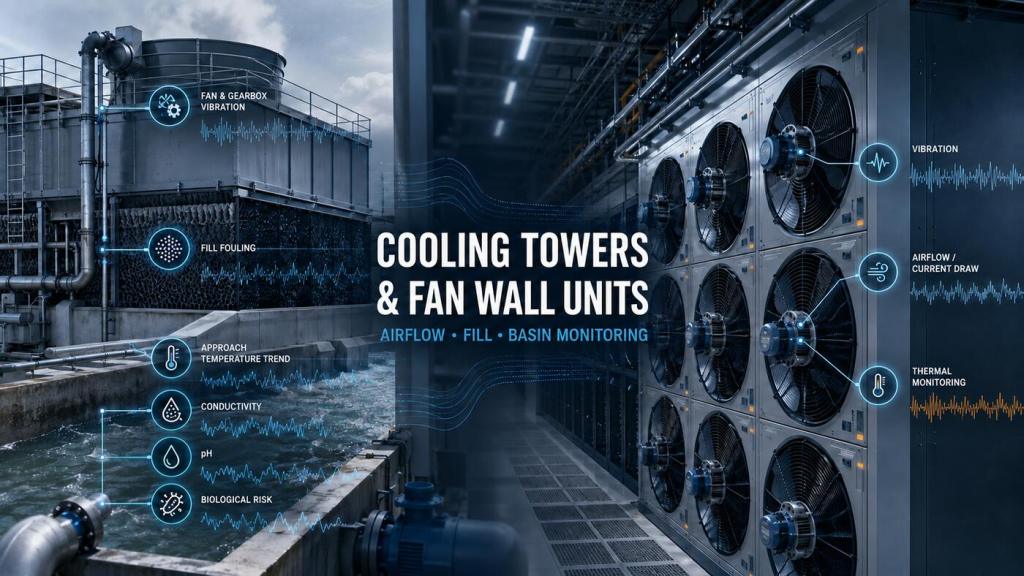
Airflow and bearing-wear data on FWUs matter more at AI-hyperscale density, where a single degraded fan bank shows up in rack inlet temps within minutes.
The thermal margin is thinner than it used to be
In a traditional data hall, a partially degraded cooling fan or a fouled cooling tower fill is an efficiency problem — the system compensates, PUE drifts slightly, and it gets caught on the next scheduled inspection without incident. In an AI hyperscale hall running at high rack density, that same degradation shows up as a thermal event. The margin between normal operation and a rack inlet temperature excursion has compressed, and it compresses further as GPU density increases.
That shift is what pulls cooling tower and fan wall unit (FWU) monitoring out of the “efficiency maintenance” category and into the same predictive-maintenance framework as UPS and chiller systems.
Fan wall units: bearing wear and airflow degradation
FWUs are made up of many individual fan modules working together to move air across a coil or through a containment system, and the failure mode that matters most is a single module degrading while the rest of the array masks the loss. Aggregate airflow readings for the unit as a whole can look normal even as one or two individual fan modules are running with worn bearings or reduced output, because the healthy modules compensate.
This is why per-module monitoring matters more than array-level monitoring:
- Vibration sensors on individual fan modules catch bearing wear the same way they do on any rotating equipment — a shifting vibration signature well before the fan fails outright.
- Per-module airflow or current draw monitoring catches a fan that’s spinning but underperforming — fouled blades, belt slip, or a failing motor — which vibration data alone might not flag if the imbalance is subtle.
- Thermal imaging across the fan wall during operation reveals modules running warmer than their neighbors, often the earliest visible sign of motor or bearing stress.
At hyperscale density, a single underperforming module in an FWU serving a high-density row doesn’t average out across the room the way it might in a lower-density facility — it shows up directly in the rack inlet temperatures for that specific row, which is why per-module data, not just array totals, is the standard this system requires.
Cooling towers: fill fouling and basin water quality
Cooling tower performance depends heavily on the condition of the fill media and the water quality in the basin, and both degrade on a timeline driven by usage and water chemistry rather than the calendar. Fill fouling — scale buildup, biological growth, debris accumulation — reduces the surface area available for heat transfer, and it happens gradually enough that approach temperature (the gap between leaving water temperature and ambient wet-bulb temperature) drifts upward slowly before it becomes an obvious problem.
Basin water quality data — conductivity, pH, biological activity — is a leading indicator for fill fouling risk, since water chemistry problems precede visible scale or growth by weeks. Tracking approach temperature trend alongside water quality data gives a clearer predictive picture than either alone: water chemistry flags the risk building, and approach temperature confirms whether it’s actually affecting performance yet.
Cooling tower fan and gearbox components follow the same vibration-monitoring logic as fan wall units and pump motors — bearing wear and misalignment produce the same kind of detectable signature ahead of failure.
Why per-unit granularity is the deciding factor here
The theme across both systems in this post is the same: aggregate, system-level readings mask individual-component degradation, and at AI-hyperscale density that masking effect is exactly what turns a quietly developing problem into a rack-level thermal incident. Monitoring at the module and fan level, not just the array or system level, is what makes the difference between catching a degrading fan during a scheduled service window and discovering it during a thermal excursion.
Put this into practice
Download the AI Hyperscale Cooling Tower and FWU Airflow, Fill and Basin Monitoring Template to register individual modules and tower cells, trend airflow, current, vibration, motor temperature, cooling-tower approach and basin chemistry, connect findings to rack inlet temperatures, assign corrective work, and verify restoration through retesting.
A biblical perspective on attentive stewardship
“Be sure you know the condition of your flocks, give careful attention to your herds.”
Proverbs 27:23 (NIV)
Predictive cooling maintenance is an expression of attentive stewardship. This verse emphasizes knowing the actual condition of what has been entrusted to us—not relying on assumptions or waiting for visible failure. Per-module airflow, vibration, rack-temperature, and water-quality monitoring put that wisdom into practice by revealing developing risks while there is still time to act.
Next in this series
Next up: PDUs and transfer/tie switches (TOU), where thermal imaging catches the failure mode that actually causes most power distribution outages — connection degradation, not component failure.

