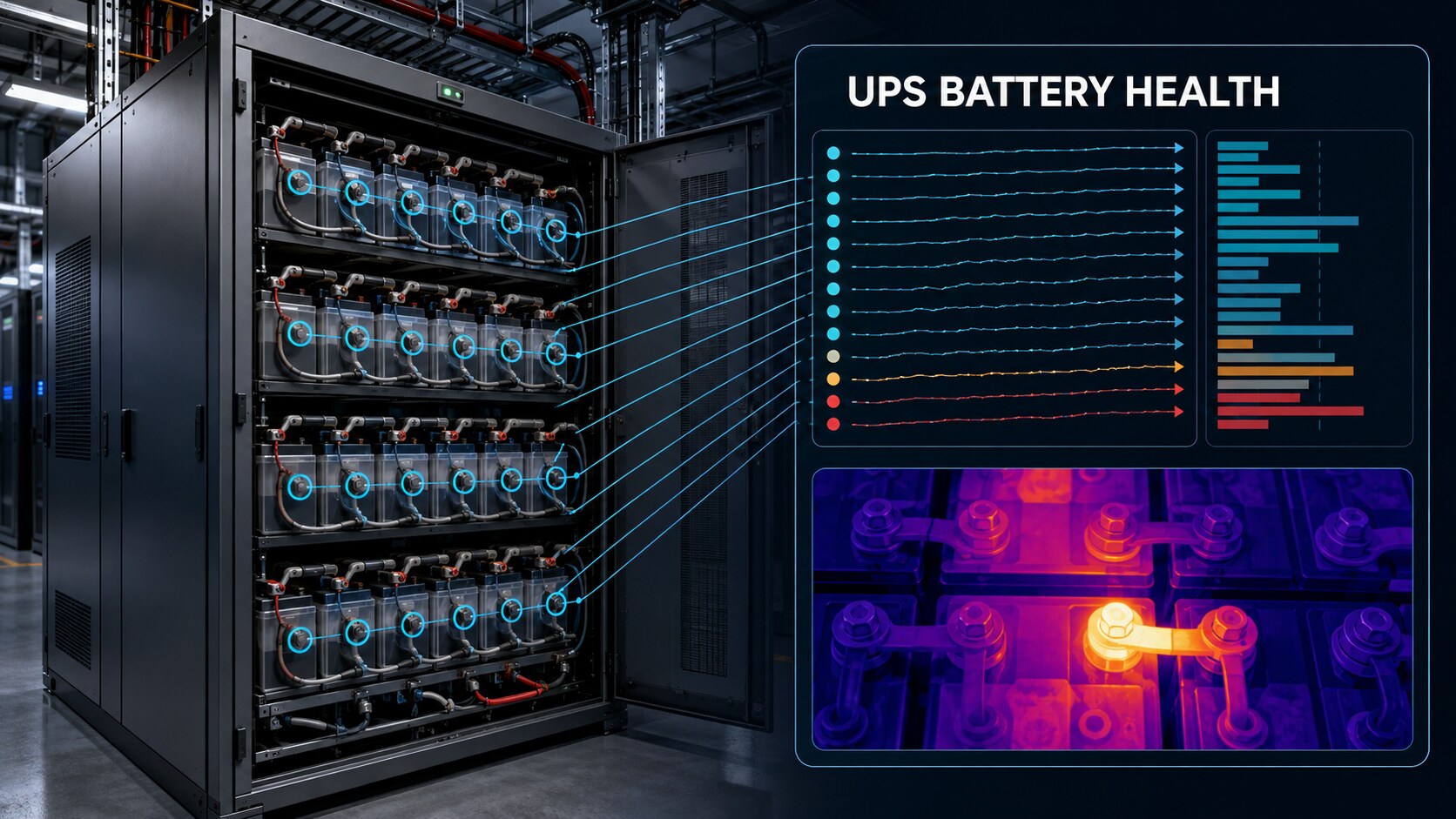
Battery health decays quietly until it doesn’t; impedance trending and thermal imaging catch what runtime tests miss.
Why the runtime test isn’t enough
The standard way to check UPS battery health is a periodic discharge or runtime test: load the battery string, confirm it holds the rated runtime, put it back in service. It’s a real test, but it only answers one question — did the string pass today. It says nothing about how close any individual cell is to failing, and it says nothing about what happens between test cycles.
Battery degradation is not linear, and it’s not uniform across a string. A string can pass a runtime test with several weak cells masked by the healthy ones around them, and those weak cells can cross a failure threshold weeks before the next scheduled test — exactly when a real utility outage puts load on the string for real.
What impedance trending actually measures
Internal impedance (or internal resistance, depending on the test method) rises as a battery cell degrades — plate corrosion, electrolyte loss, and sulfation all increase the resistance to current flow inside the cell. This rise happens well before capacity loss becomes visible on a runtime test, which makes impedance a leading indicator rather than a lagging one.
Measured and trended per cell or per jar over time, impedance data does three things a runtime test can’t:
- Identifies which specific cells are degrading, not just whether the string as a whole passed.
- Shows the rate of change, which is often more predictive than the absolute value — a cell whose impedance is climbing steadily is a different risk than one that’s been stable at a slightly elevated reading for years.
- Flags imbalance across the string, since a string with mismatched cell impedance ages its weakest cells faster and puts uneven load on them during a real discharge event.
Thermal imaging as the second data source
Impedance trending tells you which cells are degrading electrically; thermal imaging tells you which connections are degrading mechanically. Loose or corroded intercell connections show up as hot spots during float charge or discharge, and a hot connection accelerates the degradation of the cells on either side of it — so the two data sources reinforce each other rather than duplicating.
For UPS power electronics themselves (not just the battery string), thermal imaging also catches capacitor and IGBT stress before it becomes a fault — components running warmer than their baseline under the same load are a leading sign of component-level degradation.
Building the baseline
Impedance trending is only as useful as the baseline it’s measured against. A new battery string should have its per-cell impedance recorded at commissioning, not estimated from the manufacturer’s nameplate value — manufacturing variance between cells means the real baseline is specific to that string, not the datasheet. From there, readings taken on a consistent interval (commonly quarterly) build the trend line that actually predicts failure timing, rather than a single reading that just confirms current state.
What this changes operationally
With impedance and thermal data trending per cell, the maintenance conversation shifts from “did the string pass” to “which cells will need replacement in the next service window, and which strings are approaching end-of-life as a whole.” That turns battery replacement from a reactive, string-wide event into a planned, cell-level one — spreading cost over time and reducing the chance of a runtime test surprise.
Put this into practice: Download the UPS Battery Impedance and Thermal Trending Template to register every string and cell, capture a known-good baseline, trend impedance and thermal readings, prioritize findings, link work orders, and plan controlled replacement and retesting.
Next in this series
Next up: chillers and pumps, where vibration analysis and refrigerant trending do for rotating and cooling equipment what impedance trending does for batteries.

