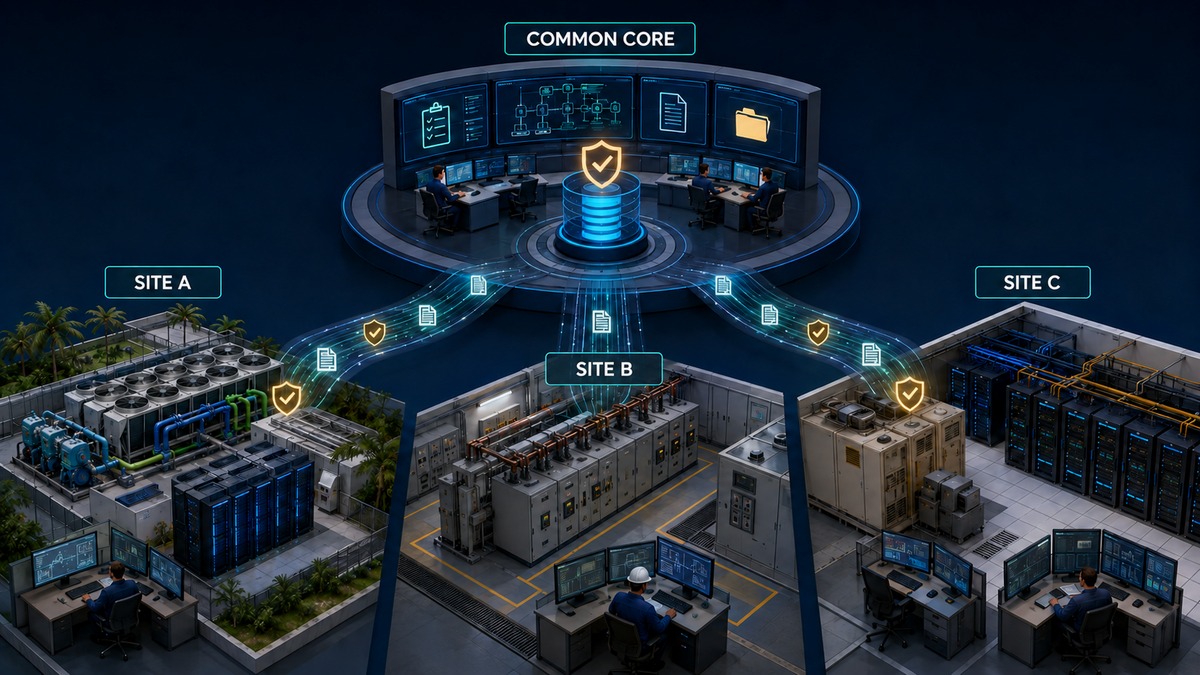
A predictive-maintenance program does not scale simply because a successful pilot is copied to another site. Asset names, system designs, climates, load profiles, suppliers, maintenance capability and risk tolerances differ. The scalable element is the operating system around the technology: common definitions, minimum controls, decision rights, evidence requirements and stage gates.
The objective is one program with comparable evidence—not identical sites forced into one configuration.
Scale the management system before scaling the sensors
ISO 55001 frames asset management as a system that aligns policy, objectives, lifecycle decisions, performance, risk and expenditure. DOE’s reliability-centered maintenance guidance similarly emphasizes selecting failure-management strategies based on reliability characteristics and operating context.
Together, these principles point to a practical rule: central standards should define how decisions are made, while each site retains responsibility for the conditions that make those decisions safe.
Before adding a second site, establish:
- Program policy and objectives
- Asset and failure-mode taxonomy
- Minimum data and cybersecurity controls
- Evidence required for an actionable condition
- Priority and escalation definitions
- Work-order and verified-closure requirements
- KPI definitions and calculation rules
- Roles for central and site teams
- Deviation and exception process
- Production-readiness gates
- Benefit-recognition and audit rules
Without this common layer, a portfolio dashboard may combine metrics that look similar but do not mean the same thing.
Decide what must be common
The following controls should usually be standardized across the program:
Asset hierarchy and identifiers
Use a common hierarchy from site and system to asset, component and measurement point. Local equipment tags can remain, but they should map to a portfolio identifier and equipment class.
Failure-mode language
“High vibration” is an observation, not a failure mode. Use controlled definitions such as bearing degradation, imbalance, misalignment, looseness or hydraulic cavitation, with the required evidence for each.
Event lifecycle
All sites should use the same status sequence, for example:
observation → validation → approved condition event → assigned work → corrective action → retest → verified closure
Minimum work-order evidence
Require asset, measurement point, baseline, operating context, corroboration, criticality, redundancy, action, procedure, retest method and acceptance criterion.
KPI definitions
Define the numerator, denominator, exclusions, time basis, owner and data source for every portfolio KPI. “Actionable-alert rate” and “verified closure” must mean the same thing at every site.
Governance gates
Every site should pass common readiness, integration and production gates before automated routing or portfolio reporting is enabled.
Decide what must remain local
Centralization becomes unsafe when it removes operating context. The following usually require site approval:
- Baselines and comparable operating conditions
- Alarm and persistence thresholds
- Asset criticality and service consequence
- Redundancy state and operational restrictions
- Maintenance windows and suppression rules
- Safety, permit and isolation requirements
- OEM and local vendor methods
- Environmental and climate factors
- Spare-parts strategy and response capability
- Regulatory and contractual obligations
A pump-vibration threshold validated at one speed and hydraulic duty should not be copied to a different pump merely because the equipment family is similar. The program can standardize the validation method while allowing the approved value to differ.
Use a common core with controlled local extensions
A scalable configuration model has three layers:
- Global minimum: mandatory definitions, controls, evidence fields and governance requirements.
- Equipment-class standard: recommended sensors, failure modes, rules, procedures and KPIs for an asset family.
- Site-approved configuration: local tags, baselines, thresholds, mappings, owners, procedures and justified deviations.
Every local extension should identify the reason, approver, effective date, review date and impact on comparability. Uncontrolled local spreadsheets and hidden rule changes are technical debt that will eventually undermine the portfolio view.
Build a federated ownership model
The central program team should own the system of work, not every maintenance decision.
Typical central responsibilities include:
- Program policy, taxonomy and templates
- Platform and integration standards
- Cybersecurity minimums
- KPI definitions and portfolio reporting
- Model and rule assurance method
- Supplier framework and commercial standards
- Cross-site learning and change control
- Audit and maturity assessment
Typical site responsibilities include:
- Asset mapping and baseline approval
- Operational context and criticality
- Local safety and maintenance procedures
- Event validation and work ownership
- Retesting and verified closure
- Local vendor and spares coordination
- Site risks, deviations and escalations
One accountable owner should exist for each material decision. A central reliability engineer may approve the method, while the site engineering manager approves a local baseline and the maintenance owner accepts the completed intervention.
Select sites by readiness, not visibility
The next rollout site should not be chosen only because it is large or senior management is interested. Assess readiness across:
- Asset-register accuracy
- Failure and maintenance history
- Sensor and data availability
- BMS/EPMS/DCIM/CMMS integration capability
- Network and cybersecurity readiness
- Baseline quality
- SOP/MOP/EOP maturity
- Operations and maintenance capacity
- Vendor and spares support
- Leadership ownership
- Ability to retest and verify outcomes
A lower-profile site with good data, ownership and procedures may create a more reliable second-wave result than a critical site with incomplete fundamentals.
Roll out in waves
A practical multi-site sequence is:
Wave 0: establish the program core
Approve taxonomy, lifecycle, RACI, minimum controls, workbook and system templates, KPI definitions, change process and production gates.
Wave 1: prove transferability
Choose one or two sites with similar asset classes but different operating conditions. Reuse the common method, document local adaptations and test whether reporting remains comparable.
Wave 2: expand by asset family
Scale mature use cases such as UPS battery impedance, critical electrical thermal inspection, rotating-equipment vibration or cooling performance. Do not scale every pilot rule merely because one site used it.
Wave 3: address complex or different sites
Bring in sites with legacy controls, different OEMs, weaker connectivity or distinct regulatory conditions after the core support model is stable.
Each wave should have entry criteria, resource limits, exit evidence and an explicit decision to scale, continue, redesign or retire.
Treat configuration as a controlled product
Portfolio rules, mappings and dashboards should have versions and owners. A change to an asset mapping, persistence rule or KPI calculation can affect multiple downstream sites.
The change record should identify:
- Proposed change and reason
- Affected sites, assets, rules and reports
- Technical and operational impact
- Validation and regression tests
- Site communication and training
- Rollback method
- Approval authority
- Effective date
- Post-implementation review
Emergency local changes may be necessary, but they should be reconciled into the controlled configuration after the immediate risk is managed.
Compare performance without creating a league table
Portfolio reporting should help sites learn, not reward alert volume or penalize honest reporting. Useful comparable metrics include:
- Data availability and sensor-health rate
- Actionable-alert rate
- Detection-to-validation time
- Validation-to-assignment time
- Work orders with complete evidence
- Completed work with comparable retesting
- Repeat-alert rate after intervention
- Planned versus emergency interventions
- Rules in exception or degraded mode
- Open high-risk deviations
- Verified realized benefits and confidence-adjusted risk scenarios
Normalize metrics where asset population or monitoring hours matter. Compare like-for-like equipment classes and operating periods. Investigate differences before attributing them to performance.
Create a cross-site learning loop
When one site confirms a useful failure signature or identifies a false-positive cause, the lesson should move through a controlled review:
- Preserve the complete case evidence.
- Determine whether the finding is site-specific or transferable.
- Test it against other equipment and operating contexts.
- Update the equipment-class standard if justified.
- Notify affected sites and define required action.
- Measure whether the change improved outcomes.
The portfolio should become more consistent because sites learn together, not because local engineering judgment is removed.
Define the production gate for each site
A site should enter portfolio production only when:
- Assets and measurement points are correctly mapped
- Local owners and escalation paths are assigned
- Baselines and thresholds are approved
- Data-quality and cybersecurity controls pass
- Integration and deduplication tests pass
- Maintenance procedures and retest criteria exist
- Teams complete scenario-based training
- Local deviations are documented
- KPI feeds reconcile with source records
- Support and recovery arrangements are sustainable
A site that has connected sensors but cannot prove these controls is connected—not production-ready.
Put this into practice
Use the companion workbook to define the global program core, assess site readiness, map asset taxonomies, manage common rules and local deviations, plan rollout waves, compare normalized KPIs, control changes and complete site production gates.
Download the Multi-Site Predictive-Maintenance Scaling and Governance Workbook
A biblical perspective on distributed responsibility
“But select capable men from all the people—men who fear God, trustworthy men who hate dishonest gain—and appoint them as officials over thousands, hundreds, fifties and tens.”
— Exodus 18:21 (NIV)
Wise scaling requires capable people, clear levels of responsibility and trustworthy judgment. One person or central team cannot safely make every local decision. A strong multi-site program establishes common principles, delegates authority to qualified owners and creates clear paths for matters that require escalation. Structure enables faithful execution without losing accountability.
The portfolio standard
A predictive-maintenance program has scaled successfully when each site can apply common definitions and controls, preserve local operating context, produce comparable evidence, learn from other sites and demonstrate verified closure without depending on informal knowledge held by a few individuals.
The goal is not identical configuration. It is consistent confidence in the decision process.

