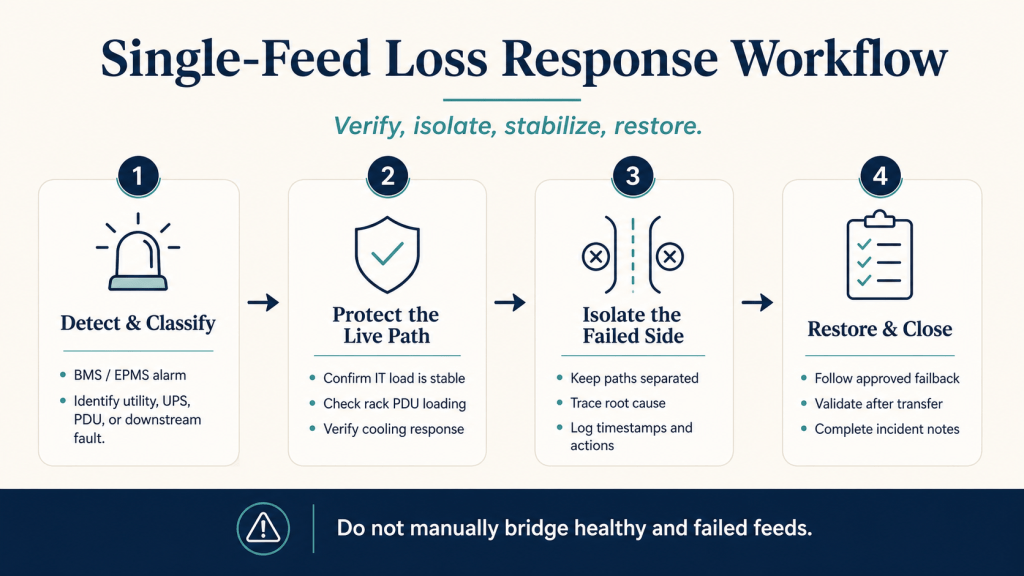
When one electrical feed fails, the team does not need a complicated playbook in the first hour. It needs a simple sequence that keeps the site safe, keeps the surviving path stable, and avoids unnecessary action.
Workflow
- Confirm the event. Verify the alarm, the scope, and whether the issue is an actual feed loss or a transient condition.
- Protect the remaining path. Keep the live feed stable and avoid changes that could reduce redundancy further.
- Check exposure. Identify which loads, racks, or branches now have less protection.
- Classify the condition. Decide whether this is a routine abnormality, a degraded state, or an emergency response.
- Communicate. Notify the right operations, facilities, and escalation contacts early.
- Record and verify. Log what happened, what changed, and what remains to be watched.
Why this works
A short workflow prevents the team from wasting the first hour debating the problem instead of controlling it. It also keeps the response aligned with SOP, MOP, or EOP instead of drifting into improvised troubleshooting.
The point is not to force a fix inside 60 minutes. The point is to make sure the site still has options after 60 minutes.
What to avoid
- Random switching without an approved procedure
- Assuming redundancy is intact without verification
- Letting one person carry the whole response
- Waiting too long to escalate
- Closing the event before the site is stable

