
When an Artificial Intelligence (AI) workload rises quickly, the facility does not need Modbus to run as fast as the Graphics Processing Unit (GPU). It needs the complete monitoring path to be fast enough, fresh enough and reliable enough for the condition being managed.
That distinction matters. A GPU can change workload in milliseconds, while a temperature, flow or electrical measurement may be refreshed, averaged and polled on a much slower timescale. Modbus transports values between equipment and monitoring systems; it does not create measurements, predict failures or determine whether a message should be treated as a notification, alert or alarm.
What Modbus does
Modbus is an application-layer communication protocol widely used to exchange data with power meters, Uninterruptible Power Supply (UPS) systems, cooling equipment, pumps, generators and Programmable Logic Controllers (PLCs). The Modbus Organization defines it as a request-and-reply protocol whose services are identified by function codes.
Two common implementations are:
- Modbus Remote Terminal Unit (RTU): Serial communication, commonly over an RS-485 physical network.
- Modbus Transmission Control Protocol (TCP): Modbus messages carried over an Ethernet Internet Protocol (IP) network, normally using TCP port 502.
A device makes measurements available in coils, discrete inputs or registers. A Modbus client, historically called a master, requests selected data. The server, historically called a slave, returns the current register contents. A Building Management System (BMS), Electrical Power Monitoring System (EPMS) or gateway then interprets those values using the correct register map, scale, signedness and byte or word order.
Modbus can continue operating while GPUs are heavily loaded because it is normally a separate Operational Technology (OT) monitoring path. However, healthy communication alone does not prove that the data is current or fast enough. A connection can be available while a sensor value is frozen, a controller refresh is slow, a gateway queue is congested or a register is decoded incorrectly.
The data path from measurement to operator action
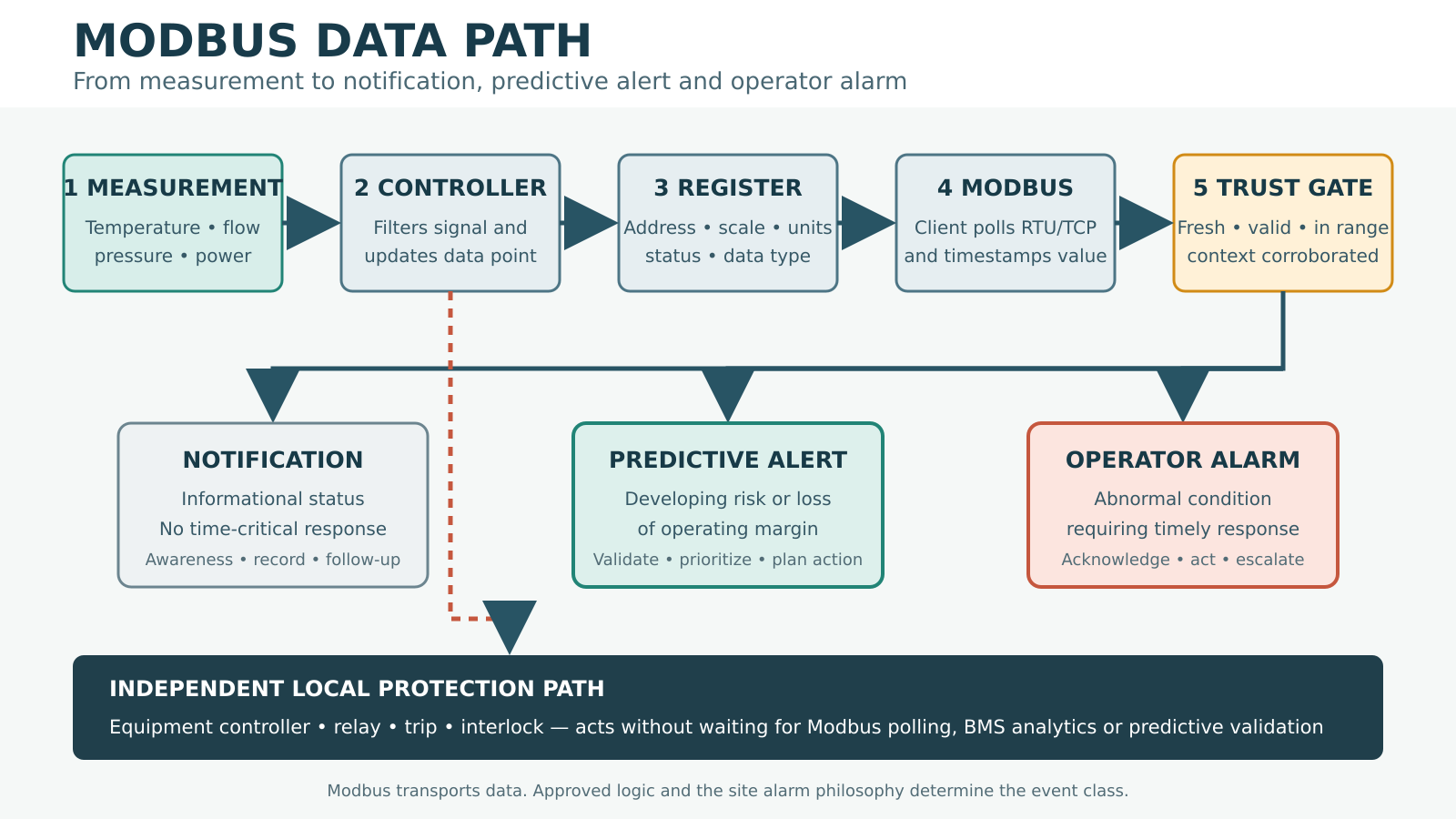
The workflow contains six supervisory stages:
- Physical measurement: A sensor measures temperature, pressure, flow, power or another condition.
- Equipment controller: The controller filters or averages the signal and updates its internal data point.
- Modbus register: The value and status are exposed at defined addresses using an approved register map.
- Client polling and gateway: The BMS, EPMS or gateway requests the data and timestamps the result.
- Data-quality gate: The system checks freshness, range, communication status, timestamps and relevant operating context.
- Event classification: Approved logic decides whether the information is a notification, predictive alert or operator alarm.
The protective path is separate. A local equipment controller, protection relay or safety interlock may act immediately without waiting for Modbus polling, the BMS or an analytics platform. Predictive monitoring should support earlier intervention, but it should not replace approved equipment protection.
Notification, predictive alert and alarm are not interchangeable
The exact names must be defined in the site's alarm philosophy. A practical distinction is:
- Notification: Informational status that improves awareness but does not presently require a time-critical operator response. Examples include a maintenance reminder, loss of a non-critical trend point or completion of a test sequence.
- Predictive alert: A developing-risk indication based on a trend, rate of change, model or combination of signals. It normally requires validation before maintenance work is created.
- Operator alarm: An audible or visible indication of an equipment malfunction, process deviation or abnormal condition requiring a timely response. This is consistent with the alarm-management principle described by the International Society of Automation (ISA).
A predictive alert should not be promoted to an operator alarm merely because a model produces a high score. The alert must meet the site's alarm criteria: defined cause, consequence, priority, response and accountable operator action. Otherwise it may create alarm fatigue without improving protection.
Why faster polling is not always faster information
The age of a value at the point of decision is the sum of several delays:
sensor response + controller update + wait for next poll + communication and gateway processing + validation and alarm evaluation
Suppose a temperature sensor and controller update their Modbus register once every two seconds, while the BMS polls every second. Polling every 100 milliseconds would mostly read the same stored value repeatedly. The system would create more network and device load without obtaining ten times more physical information.
The Modbus TCP implementation guide deliberately does not define a universal response time for a transaction. Actual performance therefore has to be measured on the installed system. For Modbus RTU, baud rate, message length, the number of devices, retries and required silent intervals affect the scan cycle. For Modbus TCP, device processing capacity, gateway design, network contention, simultaneous requests and timeout settings matter.
The fastest safe setting is not simply the smallest poll interval. The design should give critical data an appropriate scan class, read contiguous registers efficiently, avoid unnecessary duplicate clients and leave capacity for retries and diagnostics.
Can prediction provide warning ahead of an alarm?
Yes, when the failure or loss of margin has a measurable precursor and the warning arrives early enough for a useful response.
For an illustrative liquid-cooling case, rising GPU power could be correlated with Coolant Distribution Unit (CDU) flow, supply and return temperature, differential pressure, valve command and pump state. A prediction might identify that cooling response is no longer keeping pace with demand before the high-temperature alarm threshold is crossed.
Prediction does not accelerate the Modbus signal. It extracts meaning from a sequence of sufficiently fresh, synchronized and trustworthy observations. A useful engineering test is:
predicted warning time > data-path delay + validation time + operator decision time + intervention time + safety margin
If the remaining warning time is shorter than the time required to act, the prediction may explain the event but cannot prevent it. Sudden failures without a measurable precursor may offer little predictive warning, regardless of the algorithm used.
GPU-side telemetry should also be considered. NVIDIA Data Center GPU Manager (DCGM) can provide device-level utilization and activity metrics. NVIDIA notes that many profiling values are interval averages rather than instantaneous measurements. Facility and GPU timestamps, sampling intervals and aggregation windows must therefore be understood before the streams are correlated.
Simulate the path before trusting it
A controlled test should exercise the entire chain, not only confirm that a register can be read. Use approved test methods or a digital test environment; do not inject unsafe values into live equipment.
Test at least these cases:
- Normal GPU load increase with adequate cooling response.
- Developing low-flow or reduced heat-rejection performance.
- Frozen, stale or out-of-range measurement.
- Short sensor spike that should not produce an actionable alarm.
- Modbus timeout, gateway loss and delayed recovery.
- Incorrect scale, signed value, byte order or register-map version.
- Loss of one corroborating signal while other evidence remains available.
- Maintenance or commissioning state in which expected events should be suppressed or reclassified.
For every test, record the injected or simulated condition, source timestamp, controller update time, poll receipt time, event creation time, notification delivery time and operator acknowledgement. This separates communication delay from decision and response delay.
Detecting false alarms and missed alarms
A false alarm is not always an alarm-logic problem. Its apparent cause may be sensor drift, poor mounting, electrical noise, stale data, incorrect decoding, loss of operating context or a threshold without suitable persistence and deadband.
Likewise, an absence of alarms does not prove that the system is healthy. A frozen value can remain within limits indefinitely. The monitoring design should alarm or notify on data unavailability, stale timestamps and implausible signal behaviour as appropriate to consequence.
Use corroboration deliberately. A high return temperature may be credible when it agrees with rising GPU power and declining flow. If temperature rises while all related values remain flat, validate the measurement path before dispatching corrective work. Corroboration should increase confidence, not delay an urgent response to an independently critical protective alarm.
What to measure during commissioning
For each critical point, document:
- Device, unit identifier, register address, function code and data type.
- Scale, units, signedness, byte order and register-map revision.
- Sensor and controller update interval.
- Configured poll interval, timeout and retry behaviour.
- Typical and worst observed response time.
- Timestamp source and clock offset.
- Stale-data and communication-failure logic.
- Notification, predictive-alert and alarm classification.
- Persistence, deadband, suppression and reset rules.
- Required operator action and escalation time.
- Local protection or interlock that remains independent of the supervisory path.
Repeat the test under representative system load and after relevant firmware, network, gateway or control changes. A User Acceptance Test (UAT) that proves point visibility under steady conditions may still miss queueing, stale data and timing weaknesses during rapid load transitions.
Cybersecurity remains part of reliability
Traditional Modbus TCP does not by itself provide the protections expected from a modern authenticated and encrypted protocol. NIST Special Publication 800-82 Revision 3 recommends managing OT cybersecurity while respecting performance, reliability and safety requirements. Apply site-approved segmentation, access control, monitoring, secure remote access and change management.
Do not expose Modbus devices directly to untrusted networks. Restrict write functions and engineering access according to operational need. Where supported and appropriate, assess Modbus Security, which adds Transport Layer Security (TLS), but do not assume that enabling security removes the need for architecture, credential and certificate management.
Abbreviation reference
- AI: Artificial Intelligence.
- BMS: Building Management System.
- CDU: Coolant Distribution Unit.
- DCGM: Data Center GPU Manager.
- EPMS: Electrical Power Monitoring System.
- GPU: Graphics Processing Unit.
- IP: Internet Protocol.
- ISA: International Society of Automation.
- OT: Operational Technology.
- PLC: Programmable Logic Controller.
- RS-485: Recommended Standard 485 serial physical layer.
- RTU: Remote Terminal Unit.
- TCP: Transmission Control Protocol.
- TLS: Transport Layer Security.
- UAT: User Acceptance Test.
- UPS: Uninterruptible Power Supply.
A biblical perspective on early warning
“The prudent see danger and take refuge, but the simple keep going and pay the penalty.” — Proverbs 27:12 (NIV)
Early warning has value only when it is trustworthy and connected to wise action. More messages are not the goal. The goal is to recognize a credible developing risk, understand its consequence and respond before it becomes harm. Good engineering supports that prudence through reliable measurement, disciplined validation and clear responsibility.
The practical conclusion
Modbus can remain fully operational while GPU workloads change rapidly, but its suitability depends on the response required from the whole data path. Measure data age, not only network latency. Validate register interpretation, not only connectivity. Use prediction to create additional warning where evidence supports it, but preserve independent local alarms and protection.
The design succeeds when the right information becomes the right event at the right time: a notification for awareness, a predictive alert for validated early intervention, or an alarm requiring timely operator action.
Sources
- Modbus Organization: Modbus Application Protocol Specification
- Modbus Organization: Modbus Messaging on TCP/IP Implementation Guide
- Modbus Organization: Modbus over Serial Line Specification and Implementation Guide
- International Society of Automation: ISA-18 alarm-management overview
- NIST SP 800-82 Revision 3: Guide to Operational Technology Security
- NVIDIA DCGM profiling documentation

