
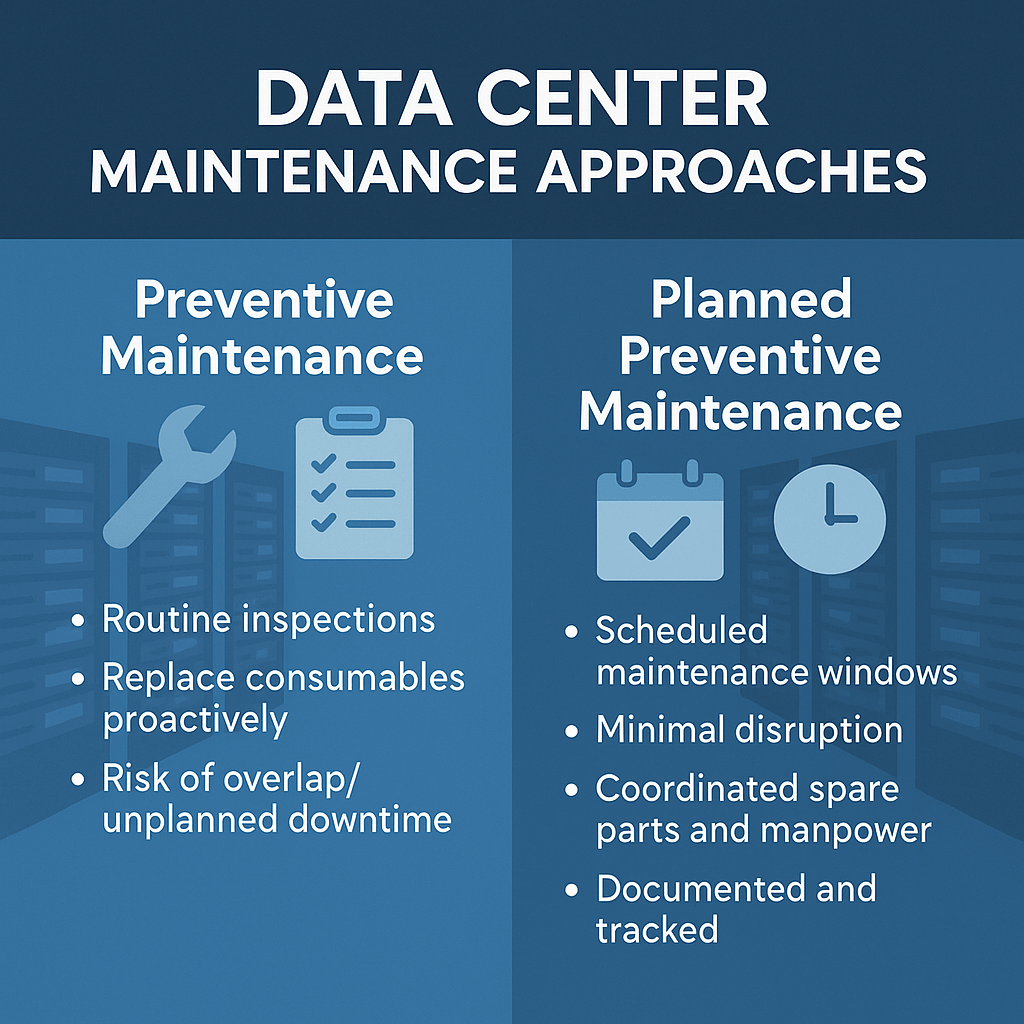
Running a data center is like tuning an orchestra—every piece needs to hit the right note at the right time. If one instrument is off (looking at you, UPS or chiller), the whole symphony suffers. That’s why Planned Preventive Maintenance (PPM) isn’t just a good idea—it’s a survival strategy.
In this guide, we’re going to walk you through:
- A wide range of maintenance frequencies (including bi-monthly to 10-yearly intervals)
- When to switch from preventive to predictive maintenance (especially after major corrective work)
- How to manage consumables across critical components like generators, chillers, UPS, CRACs, and more
- How to stay ahead of issues with early detection systems—like hydrogen leak monitoring, fire suppression, and water leakage
Let’s break it down!
Maintenance Frequencies: From Daily to Decade-Long Intervals
Not all data center components need the same attention. Here’s a comprehensive look at typical PPM frequencies used in modern data centers:
| Frequency | Typical Tasks | Applies To |
|---|---|---|
| Daily | Visual inspections, alarm log reviews, temperature/humidity checks | CRAC, UPS, battery room, monitoring dashboards |
| Weekly | Generator oil/fuel level checks, HVAC air filter checks, water system levels | Generators, Cooling towers, Chillers |
| Bi-Monthly | Functional testing of minor backup systems, check V-belts, valve operation | AHU, FCU, CRAC, fire pump, harmonics filters |
| Monthly | Run diesel genset on load, test fire detection, inspect UPS battery voltage | Generator, Fire system, UPS |
| Quarterly | HVAC filter replacement, battery discharge test, valve check | UPS, CRAC, fire sprinklers |
| Semi-Annually | Cooling tower cleaning, harmonics filter testing, chiller performance evaluation | Cooling systems, power quality equipment |
| Annually | Infrared thermography, pressure testing, UPS capacitor testing, generator overhaul | Electrical panels, UPS, generator, fire suppression |
| 2-Yearly | Replace generator coolant, flush water piping, test full-load UPS | Generators, piping, water systems |
| 3-Yearly | Overhaul major mechanical parts (valves, actuators), replace key sensors | Cooling system, fire detection systems |
| 5-Yearly | Replace UPS battery banks, harmonic filters, inspect cable integrity | UPS, Power Distribution, harmonics filters |
| 7-Yearly | Comprehensive overhaul on chillers and generators, change refrigerants | Chillers, generators |
| 10-Yearly | Major infrastructure upgrade review, refit fire suppression systems, pipe replacements | Fire suppression, water systems, infrastructure planning |
When PPM Becomes Predictive Maintenance
Here’s the truth: PPM isn’t the endgame—predictive maintenance is.
So, when should you make the shift? A strong trigger is when your corrective maintenance becomes “significant”, like:
- Replacing multiple major components in short succession
- Unexpected downtime caused by part failure
- Deviation from expected system performance metrics
If you’ve had two or more of the above within 6–12 months, it’s time to introduce predictive tools, like:
- Vibration analysis for rotating equipment
- Thermal imaging for electrical load centers
- Condition-based monitoring (CBM) for UPS and chillers
- IoT-based hydrogen sensors in battery rooms
- Data analytics to predict part failure based on usage cycles
Switching to predictive maintenance helps in cost avoidance, increases asset longevity, and reduces surprise outages.
Smart Management of Consumables in Critical Infrastructure
Here’s where things get real—consumables don’t just mean filters and oil. Every critical system has parts that wear down, expire, or degrade. Let’s look at each in more detail:

Uninterruptible Power Supply (UPS)
Consumables:
- Batteries (typically every 3–5 years)
- Capacitors (5–7 years)
- Fans and filters
Signs to Replace:
- Voltage drop under load
- Battery float voltage fluctuation
- Alarms for overheating or ventilation issues
Generator
Consumables:
- Fuel filters, oil filters, lubricants (changed bi-monthly to quarterly)
- Coolants (2-yearly)
- Battery (3–5 years)
- Belts and hoses (check annually)
Pro Tips:
- Load bank testing is critical annually
- Keep a record of runtime hours and replace parts appropriately
Cooling Tower
Key Components:
- Drift eliminators, fill media, fans, motors, water pumps
Consumables & Frequencies:
- Chemical dosing (daily to weekly)
- Filter cleaning/replacement (monthly)
- Full descaling and disinfection (semi-annually)
Chillers
Consumables:
- Refrigerant (7-yearly or as needed)
- Filters and strainers (quarterly)
- Compressor oil (annually)
- Motor bearings (check semi-annually)
Key Maintenance:
- Performance testing (semi-annually)
- Vibration monitoring for compressor wear
Water & NEWater Systems
Items to Track:
- Filters and softeners (monthly)
- Valve actuation (bi-monthly)
- Leak sensors (weekly)
- Pipe inspections (2- to 10-year cycles)
CRAC / AHU / FCU
Consumables:
- Air filters (monthly to quarterly)
- Blower belts (annually)
- Humidifiers/dehumidifiers (check annually)
- Dampers and actuators (3–5 years)
Fire Systems (Sprinkler & Detection)
Consumables:
- Smoke and heat detectors (clean quarterly, test annually)
- Sprinkler heads (visual monthly, pressure test annually)
- Fire suppression cylinders (hydro-test every 10 years)
- Gas suppression panels (battery change 3–5 years)
Early Detection Systems
Hydrogen Leak Detection:
- Install gas sensors in battery rooms
- Replace sensors every 3–5 years
- Calibrate annually
Smoke Detection & Fire Suppression:
- Use aspirating smoke detectors for early detection
- Test suppression agents (FM-200, Novec) annually
- Replace agent bottles based on manufacturer shelf life (typically 10 years)

Key Practices to Keep in Mind
- Always follow OEM guidelines—they vary by manufacturer
- Keep a maintenance logbook or digital CMMS (Computerized Maintenance Management System)
- Use thermal imaging and power quality analyzers to detect inefficiencies
- Train staff to recognize early warning signs
❓ FAQs
What happens if I skip preventive maintenance?
You not notice it today. Still, skipping routine checks often leads to higher corrective costs. It also causes unplanned downtime and reduces the lifespan of critical systems.
When do I overhaul my UPS?
Usually at the 5-year mark or when battery performance dips below 80% of rated output.
Is predictive maintenance expensive?
It requires upfront investment in sensors and analytics tools, but it pays off by drastically reducing unexpected failures.
📌 Wrapping Up: Is Your Maintenance Strategy Future-Ready?
Data centers can’t afford downtime, and the best way to avoid it is by staying ahead. A layered maintenance regime is essential. It includes everything from daily checks to decade-level upgrades. This ensures every system, from chillers to detection systems, performs efficiently.
When significant corrective work starts becoming a trend, don’t just fix—predict. The future of facility reliability lies in data-driven decision-making and proactive replacement of consumables before they compromise uptime.
💡 Feeling like your current maintenance plan is a little outdated? Maybe it’s time to upgrade from PPM to a hybrid predictive model.
🔗 Interesting External Reads:
- Uptime Institute – Tier Standards
- ASHRAE Guidelines for Data Centers
- NFPA 75: Standard for the Fire Protection of Information Technology Equipment
 Data Center Health