
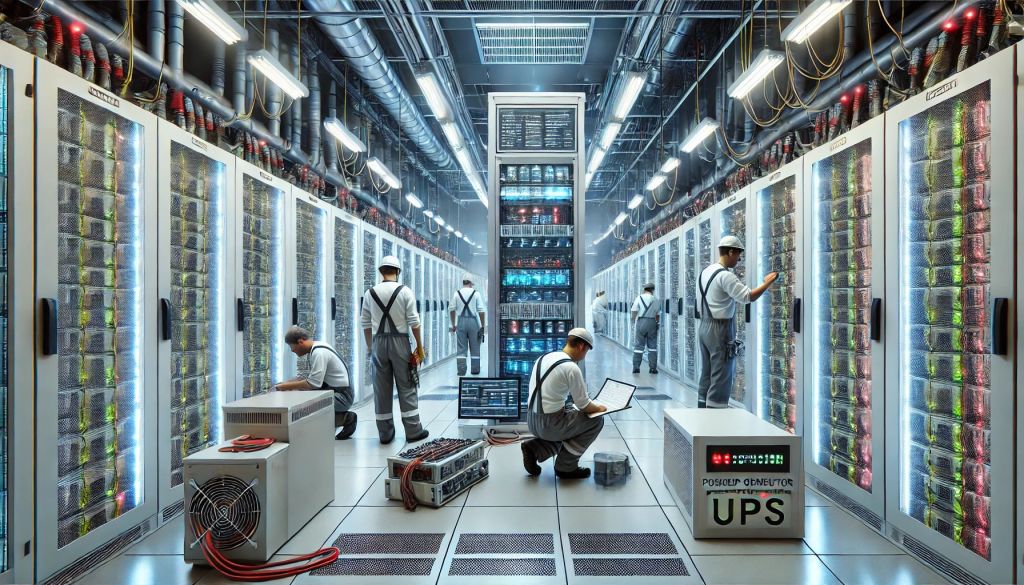
1. Redundant Infrastructure Design
Dual Power Paths: Hyperscale data centers often use dual power feeds (A and B feeds). Each piece of equipment, including the UPS, STS, and PDU, is connected to both power feeds. This allows maintenance on one path while the other path provides uninterrupted power to the critical load.
Redundant UPS Systems: Implement a parallel redundancy for UPS systems (e.g., N+1 or 2N configurations). This setup ensures that if one UPS needs maintenance, the other(s) can continue supplying power.
Redundant PDUs: Have redundant PDUs so that power can be switched to a secondary unit while one is under maintenance.
2. Hot-Swappable Components
Use hot-swappable UPS modules, which can be replaced or maintained without shutting down the entire system. This allows service personnel to replace batteries or other components while the remaining modules continue to operate.
Ensure hot-swappable circuit breakers are installed, allowing individual circuits to be isolated for maintenance without impacting the overall power delivery.
3. Load Transfer and Transfer Switching
Static Transfer Switches (STS): Use STS to automatically switch power sources in case of an issue with one power path. During maintenance, the load can be transferred to an alternate power source without interruption, allowing maintenance of the original path.
Manual Bypass Switches: Incorporate manual bypass switches into the design, allowing maintenance staff to manually route power around equipment that needs servicing.
4. Maintenance on a Zone Basis
Divide the data center into zones or segments that can be isolated for maintenance. This zoning strategy allows maintenance on one area while the rest remains fully operational.
For example, maintenance can be performed on Zone A while Zone B and C remain powered and operational, provided that the loads can be temporarily adjusted.
5. Scheduled Maintenance Windows
Plan maintenance during low-load periods or times when customer demand is lower. While power may not be turned off, lower demand allows more room for rebalancing loads across redundant systems.
Use real-time monitoring tools to predict power demand and identify optimal time slots for maintenance with minimal impact.
6. Use of Generators During Maintenance
For some operations, use standby generators to temporarily support the load while UPS units or other critical power components are being serviced. This strategy ensures uninterrupted power even if a primary component is under maintenance.
Ensure that generators are properly synchronized with the existing power infrastructure to avoid power surges or transfer issues during the switchover.
7. Implement an Effective Maintenance Protocol
Use a comprehensive maintenance management system to plan and track all maintenance activities without downtime. This includes proper documentation of every step to ensure that redundancy is maintained throughout the process.
Perform preventive maintenance on redundant components more frequently than non-redundant systems. This reduces the likelihood of needing emergency maintenance on critical power infrastructure.
8. Testing and Simulation
Simulate Failover Scenarios: Regularly test failover scenarios to ensure that systems switch seamlessly to backup power sources. This includes mock tests of the STS and bypass systems to verify their performance during maintenance.
Verify Automatic Transfer Switches (ATS): Test the ATS functionality regularly to ensure it switches power sources smoothly, allowing for maintenance on the primary power source.
9. Coordination with Vendors and Experts
Work with power system experts and equipment vendors to ensure that all components are maintained according to the latest standards and best practices. These experts can often provide insights into performing maintenance safely without interruption.
Have a vendor support contract in place for immediate assistance if an issue arises during maintenance.
10. Remote Monitoring and Predictive Maintenance
Implement remote monitoring tools that track the health of UPS, STS, and PDUs in real-time. This enables maintenance teams to detect potential issues early and perform maintenance proactively.
Use predictive analytics to forecast when components are likely to need maintenance, allowing for scheduled interventions without emergency shutdowns.
By employing a combination of these strategies, hyperscale data centers can conduct maintenance safely without shutting down critical power systems, ensuring continuous uptime and reliability for their clients. The redundancy and planning ensure that even during maintenance, the power supply remains uninterrupted.
Here is the Chinese version of how to provide hyperscale data center maintenance without having to shut down any critical power components:
1. 冗余基础设施设计
双电源路径:超大规模数据中心通常使用双电源(A和B路径)。每个设备,包括UPS、STS和PDU,都连接到这两个电源路径。这样可以在一个路径进行维护时,另一个路径仍然为关键负载提供不间断的电力。
冗余UPS系统:实施UPS系统的并联冗余(例如N+1或2N配置)。这种设置确保如果一个UPS需要维护,其他UPS可以继续供电。
冗余PDU:配备冗余PDU,以便在一个PDU维护时,可以切换到备用PDU继续供电。
2. 支持热插拔的组件
使用支持热插拔的UPS模块,这样可以在不关闭整个系统的情况下更换或维护。这使得维护人员能够在其他模块继续运行时更换电池或其他部件。
确保安装热插拔断路器,可以隔离单个电路进行维护,而不影响整体供电。
3. 负载切换和转换开关
静态转换开关(STS):使用STS在出现电源路径问题时自动切换电源。在维护期间,可以将负载转移到备用电源,确保无中断地进行维护。
手动旁路开关:在设计中集成手动旁路开关,使维护人员能够手动绕过需要维护的设备来重新分配电力。
4. 按区域进行维护
将数据中心划分为可以隔离维护的区域或部分。此策略允许在某个区域进行维护,而其他区域保持正常运行。
例如,可以在A区进行维护,同时B区和C区保持供电和运行,只要负载可以临时调整。
5. 计划性维护时间窗口
在低负载时期或客户需求较低的时间进行维护。虽然不需要断电,但在低需求时进行维护可以更好地重新平衡冗余系统中的负载。
使用实时监控工具预测电力需求,找出对运营影响最小的最佳维护时段。
6. 在维护期间使用发电机
在某些操作中,可以使用备用发电机临时支持负载,同时维护UPS或其他关键电力组件。此策略确保即使主要组件处于维护状态,电力仍然不中断。
确保发电机与现有电力基础设施正确同步,以避免在切换电源时出现电压波动或其他问题。
7. 实施有效的维护协议
使用综合维护管理系统来计划和跟踪所有维护活动,确保在不影响正常运行的情况下进行维护。包括每一步的详细记录,以确保在整个过程中维持冗余。
对冗余组件进行比非冗余系统更频繁的预防性维护,以减少关键电力设施紧急维护的可能性。
8. 测试与模拟
模拟故障切换场景:定期测试故障切换场景,以确保系统在维护期间能够无缝切换到备用电源。这包括对STS和旁路系统的模拟测试,以验证其性能。
验证自动转换开关(ATS):定期测试ATS功能,确保其能够顺利切换电源源,从而在主要电源进行维护时提供支持。
9. 与供应商和专家协调
与电力系统专家和设备供应商合作,确保所有组件的维护符合最新标准和最佳实践。这些专家通常能为如何在不间断电力的情况下进行维护提供宝贵的建议。
签订供应商支持合同,以便在维护期间如有问题发生时,能立即获得专业帮助。
10. 远程监控与预测性维护
实施远程监控工具,实时跟踪UPS、STS和PDU的运行状态。这使维护团队能够提前发现潜在问题,并主动进行维护。
使用预测分析来预估组件何时需要维护,从而可以有计划地进行干预,而不是紧急停机。
通过结合这些策略,超大规模数据中心可以在不关闭关键电力系统的情况下进行维护,确保服务的连续性和客户的高可靠性。冗余和合理规划在整个过程中确保即使在维护期间,电力供应也不会中断。
 Data Center Health